

Flex-PLI Legform
Publishdate:2025-12-12 Views:78
Flex-PLI legform Impactor
Flex-PLI (Flexible Pedestrian Legform Impactor) is a testing device used to assess the risk of pedestrian legform injuries caused by crash with the front structure of vehicles. Compared to earlier rigid legforms, it can more realistically simulate the biomechanical response of the human lower limbs during crash.
This impactor is the core test tool for the United Nations Regulation UN R127, 3rd edition, and the mandatory Chinese standard GB 24550-2024. It is suitable for pedestrian protection assessments of M1 and N1 category vehicles, especially for crash scenarios where the bumper height is below 425 mm. Since 2014, the Euro-NCAP has adopted the Flex-PLI as a statutory test device, replacing earlier rigid legforms (such as TRL), to more comprehensively assess the risks of knee ligament injuries and long bone fractures.
JASTI has been developing and manufacturing the final specification model (Global Technical Regulation, GTR) since 2013. By the end of 2015, product prototype evaluations were completed both overseas and in Japan. Production and sales began in 2016, and the product has been widely used in Japan, China, India, Europe, and other regions.
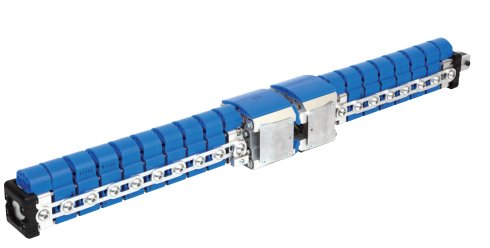
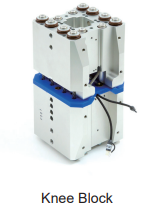
The knee joint is composed of a Knee Block made of cut aluminum, which is connected to the upper and lower parts through 12 spring wires. Four displacement meters are used to measure the elongation displacement of the knee joint simultaneously. To facilitate the accumulation of bending moments of the femur and tibia, as well as displacement data of the knee, a data accumulation function has been added to the inner side of the knee.
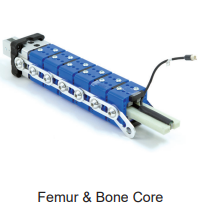
The Flex-PLI calibration test is as follows:
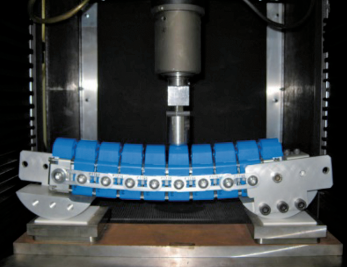
Three-point bending of lower leg
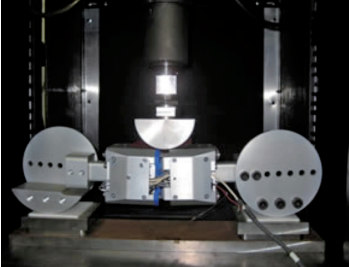
Three-point bending of the knee
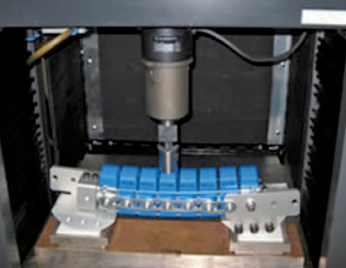
Three-point bending of lower leg
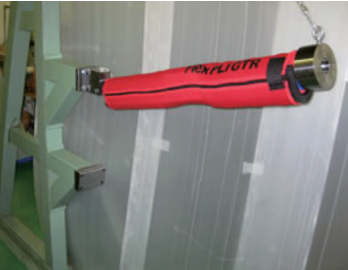
Overall arm swing impact
Flex-PLI legform Impactor
Flex-PLI (Flexible Pedestrian Legform Impactor) is a testing device used to assess the risk of pedestrian legform injuries caused by crash with the front structure of vehicles. Compared to earlier rigid legforms, it can more realistically simulate the biomechanical response of the human lower limbs during crash.
This impactor is the core test tool for the United Nations Regulation UN R127, 3rd edition, and the mandatory Chinese standard GB 24550-2024. It is suitable for pedestrian protection assessments of M1 and N1 category vehicles, especially for crash scenarios where the bumper height is below 425 mm. Since 2014, the Euro-NCAP has adopted the Flex-PLI as a statutory test device, replacing earlier rigid legforms (such as TRL), to more comprehensively assess the risks of knee ligament injuries and long bone fractures.
JASTI has been developing and manufacturing the final specification model (Global Technical Regulation, GTR) since 2013. By the end of 2015, product prototype evaluations were completed both overseas and in Japan. Production and sales began in 2016, and the product has been widely used in Japan, China, India, Europe, and other regions.
The knee joint is composed of a Knee Block made of cut aluminum, which is connected to the upper and lower parts through 12 spring wires. Four displacement meters are used to measure the elongation displacement of the knee joint simultaneously. To facilitate the accumulation of bending moments of the femur and tibia, as well as displacement data of the knee, a data accumulation function has been added to the inner side of the knee.
The Flex-PLI calibration test is as follows:
Three-point bending of lower leg
Three-point bending of the knee
Three-point bending of lower leg
Overall arm swing impact
- Previous:FMVSS226 Headform
- Next:aPLI Legform