

AI Dummy Injury Assessment Software
Publishdate: Views:
AI Dummy Injury Assessment Software
In the field of automotive passive safety analysis, the real engineering implementation of AI technology in CAE simulation lies in how to apply AI algorithms to replace CAE simulation calculations and accelerate product design. Based on years of experience in finite element dummy model development and passive safety project implementation, Dynawe has developed AI dummy injury assessment software based on machine learning AI algorithms through close cooperation with customers.
In traditional CAE passive safety simulation analysis, the integration and matching of restraint systems heavily rely on CAE simulation, which is both time-consuming and labor-intensive. Especially when it comes to parameter selection and optimization, due to computational resources and time constraints, engineers often have to rely on their experience to select a limited number of schemes for simulation and comparison, making it difficult to find the global optimal solution. However, by developing methods such as AI-Dummy, time-consuming CAE simulation calculations can be replaced. Especially in the early stages of product development, it is convenient to optimize the design of restraint system-related parameters, select schemes, and decompose objectives.
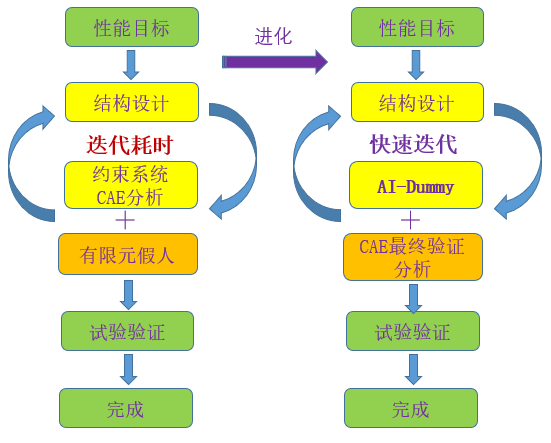
Comparison between AI-Dummy analysis process and traditional CAE analysis process
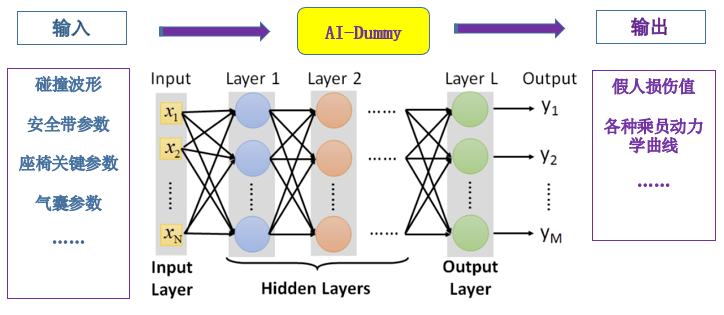
Input and output of AI-Dummy
Features of AI dummy injury assessment software:
- Based on the existing finite element dummy model, a large number of application case samples are calculated. Collaborating with clients, a vast dataset of CAE simulation analysis results is utilized for AI-Dummy training, ultimately yielding an offline trained AI-Dummy model;
- Utilize a vast amount of customer trial data to fine-tune and adjust the AI-Dummy model, thereby enhancing the reliability of its prediction results, with a prediction accuracy exceeding 90%;
- The AI-Dummy model includes H305, H350, H395, Thor50, WorldSID50, SID-IIs, ES2/ES2-RE, Q3, Q6, Q10, BioRID2, Flex-PLI, and aPLI, etc;
- The trained AI-Dummy is defined based on different positions of the dummy placed inside the car, and is applicable to all vehicle types, including large, medium, and small ones;
- Due to significant differences in product parameters of restraint systems and varying vehicle stiffnesses among different original equipment manufacturers (OEMs) or component suppliers, there are disparities in data distribution. When deploying this AI dummy injury assessment software across different manufacturers, minor batch training and fine-tuning are required to adapt to the specific vehicle characteristics of each manufacturer.
- The software seamlessly integrates with LS-OPT parameter optimization software, enabling various parameter optimization analyses with second-level computational efficiency. It supports both standalone deployment and cloud deployment, truly achieving global optimization in design. This elevates precision design and efficiency improvement to another level, allowing engineers to shift their focus to higher-value innovation areas and the solution of engineering problems;
- The training of all AI-Dummy models requires close collaboration with interested manufacturers. Dynawe provides the software environment, AI training algorithms, and various high-precision finite element dummy models.
Selection of operating conditions and definition of operating condition library:
Based on the trained AI-Dummy model, according to different regulatory analyses (such as E-NCAP, C-NCAP, C-IASI, IIHS, or GB), it is convenient to select the dummy seat position (driver, passenger, rear left, and rear right) in the software. Then, input the crash waveform to evaluate the dummy injury output, as shown in the figure below:
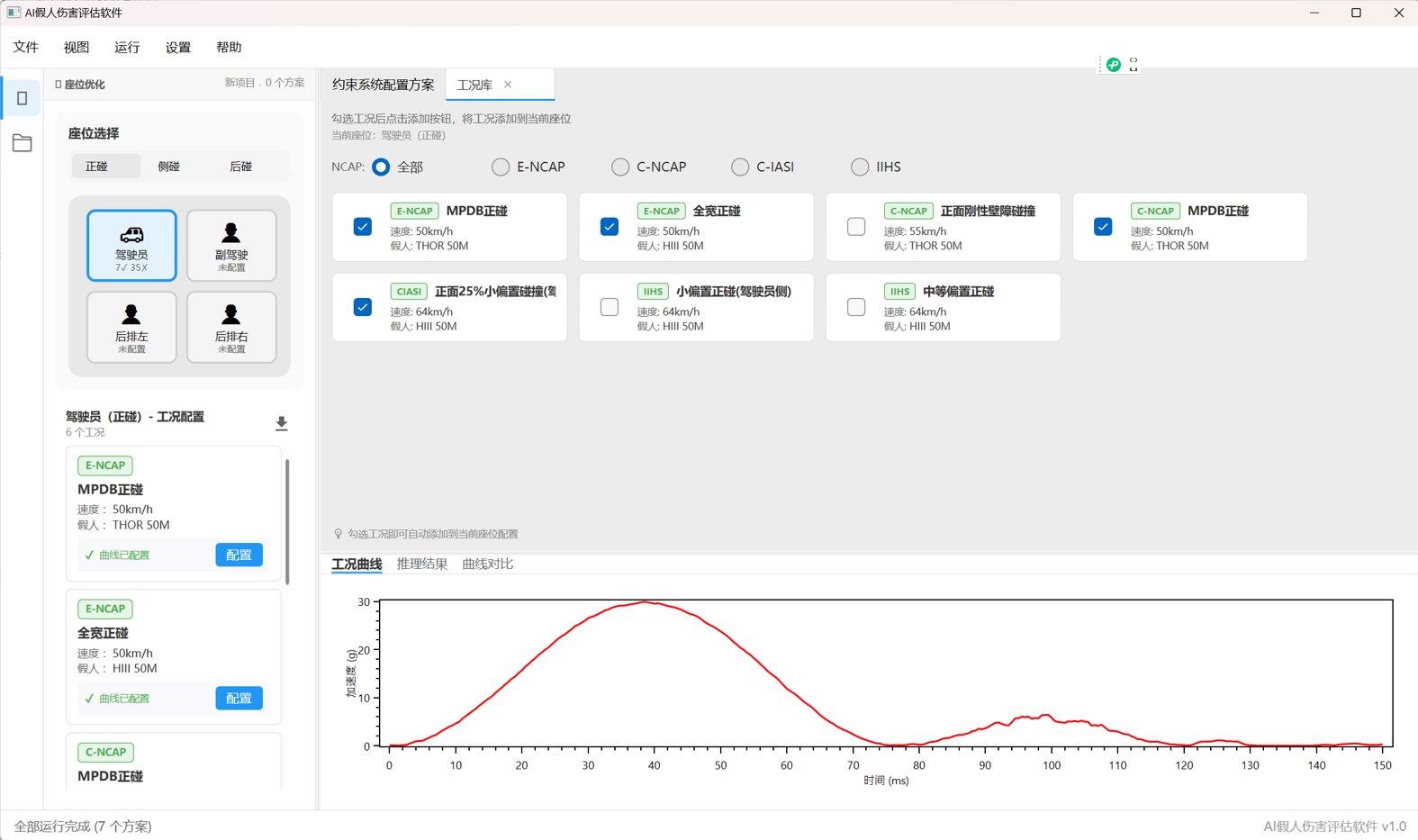
Selection of operating conditions for software
The software will incorporate various condition libraries, including MPDB frontal collision, full-width frontal collision, side MDB, side pole collision, and far-end side collision, and will be compatible with various regulations, facilitating users in selecting various conditions for dummy injury value prediction.
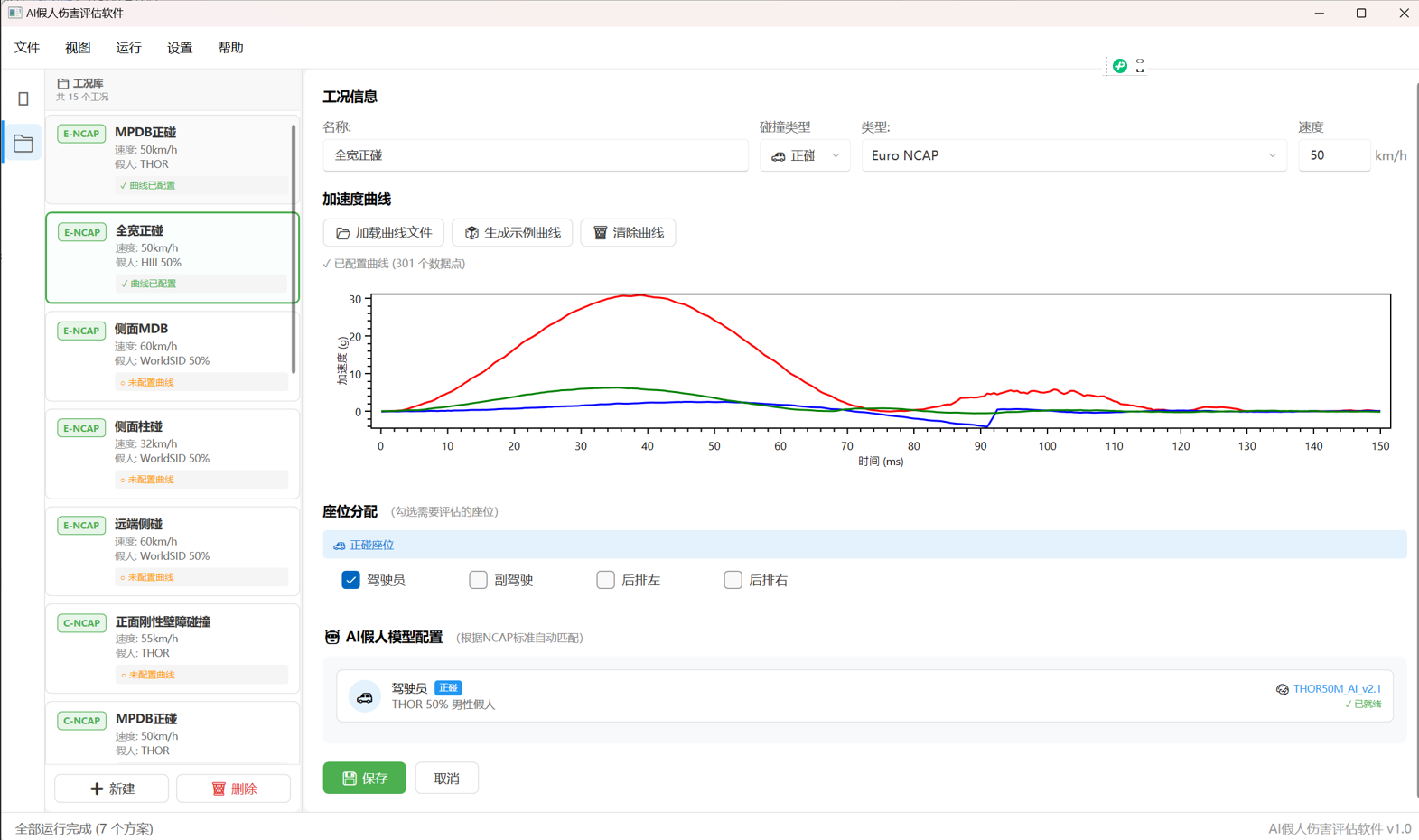
Software operating condition library setting
Based on the above operating conditions, rapid prediction and curve comparison of various configuration schemes for the restraint system can be conducted. In the later stage, LS-OPT optimization software can be integrated for optimal design.
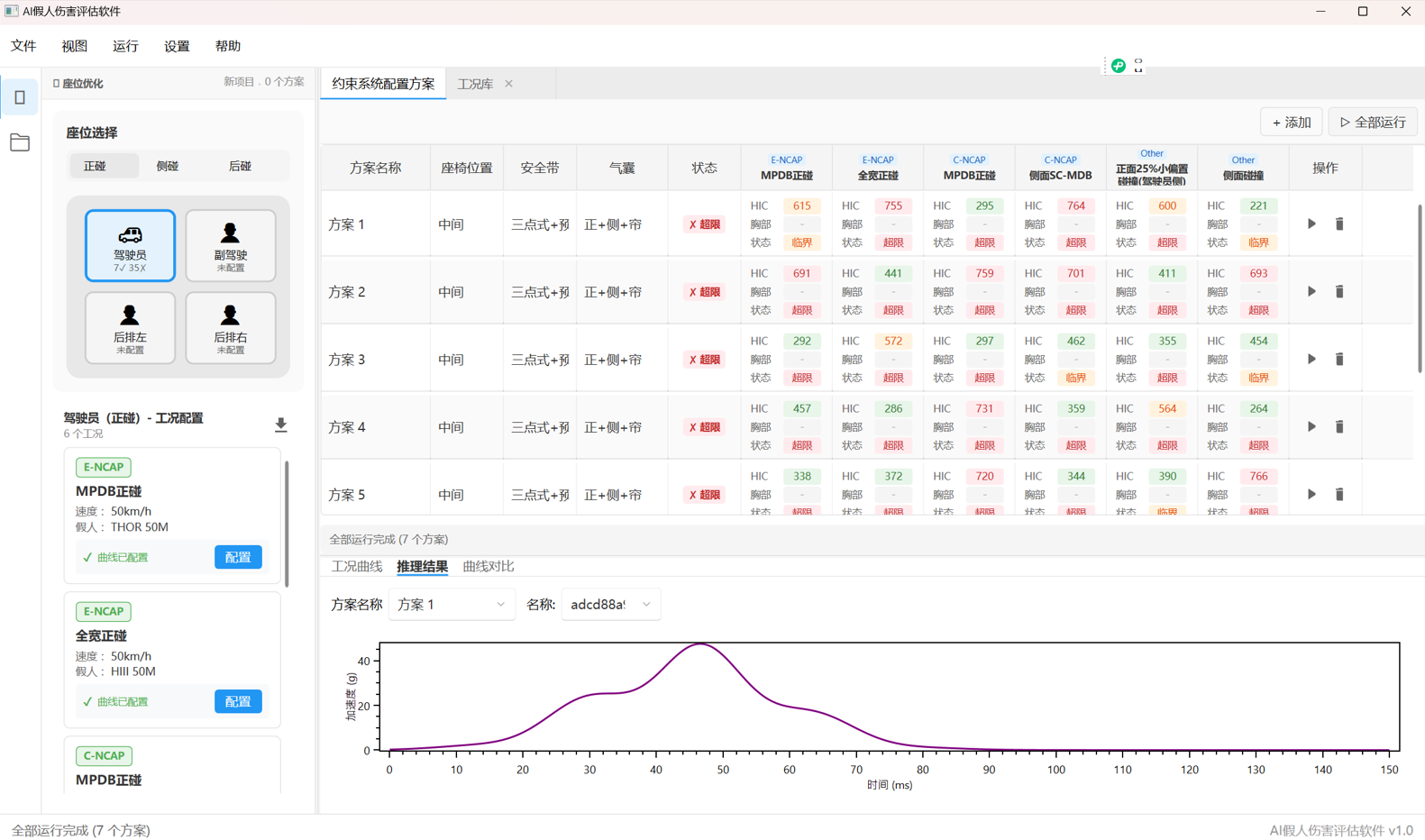
AI dummy damage prediction operation
The current version can perform predictive evaluation on discrete variables and continuous curves, and subsequent development versions will predict and output animation results.
AI Dummy Injury Assessment Software
In the field of automotive passive safety analysis, the real engineering implementation of AI technology in CAE simulation lies in how to apply AI algorithms to replace CAE simulation calculations and accelerate product design. Based on years of experience in finite element dummy model development and passive safety project implementation, Dynawe has developed AI dummy injury assessment software based on machine learning AI algorithms through close cooperation with customers.
In traditional CAE passive safety simulation analysis, the integration and matching of restraint systems heavily rely on CAE simulation, which is both time-consuming and labor-intensive. Especially when it comes to parameter selection and optimization, due to computational resources and time constraints, engineers often have to rely on their experience to select a limited number of schemes for simulation and comparison, making it difficult to find the global optimal solution. However, by developing methods such as AI-Dummy, time-consuming CAE simulation calculations can be replaced. Especially in the early stages of product development, it is convenient to optimize the design of restraint system-related parameters, select schemes, and decompose objectives.
Comparison between AI-Dummy analysis process and traditional CAE analysis process
Input and output of AI-Dummy
Features of AI dummy injury assessment software:
- Based on the existing finite element dummy model, a large number of application case samples are calculated. Collaborating with clients, a vast dataset of CAE simulation analysis results is utilized for AI-Dummy training, ultimately yielding an offline trained AI-Dummy model;
- Utilize a vast amount of customer trial data to fine-tune and adjust the AI-Dummy model, thereby enhancing the reliability of its prediction results, with a prediction accuracy exceeding 90%;
- The AI-Dummy model includes H305, H350, H395, Thor50, WorldSID50, SID-IIs, ES2/ES2-RE, Q3, Q6, Q10, BioRID2, Flex-PLI, and aPLI, etc;
- The trained AI-Dummy is defined based on different positions of the dummy placed inside the car, and is applicable to all vehicle types, including large, medium, and small ones;
- Due to significant differences in product parameters of restraint systems and varying vehicle stiffnesses among different original equipment manufacturers (OEMs) or component suppliers, there are disparities in data distribution. When deploying this AI dummy injury assessment software across different manufacturers, minor batch training and fine-tuning are required to adapt to the specific vehicle characteristics of each manufacturer.
- The software seamlessly integrates with LS-OPT parameter optimization software, enabling various parameter optimization analyses with second-level computational efficiency. It supports both standalone deployment and cloud deployment, truly achieving global optimization in design. This elevates precision design and efficiency improvement to another level, allowing engineers to shift their focus to higher-value innovation areas and the solution of engineering problems;
- The training of all AI-Dummy models requires close collaboration with interested manufacturers. Dynawe provides the software environment, AI training algorithms, and various high-precision finite element dummy models.
Selection of operating conditions and definition of operating condition library:
Based on the trained AI-Dummy model, according to different regulatory analyses (such as E-NCAP, C-NCAP, C-IASI, IIHS, or GB), it is convenient to select the dummy seat position (driver, passenger, rear left, and rear right) in the software. Then, input the crash waveform to evaluate the dummy injury output, as shown in the figure below:
Selection of operating conditions for software
The software will incorporate various condition libraries, including MPDB frontal collision, full-width frontal collision, side MDB, side pole collision, and far-end side collision, and will be compatible with various regulations, facilitating users in selecting various conditions for dummy injury value prediction.
Software operating condition library setting
Based on the above operating conditions, rapid prediction and curve comparison of various configuration schemes for the restraint system can be conducted. In the later stage, LS-OPT optimization software can be integrated for optimal design.
AI dummy damage prediction operation
The current version can perform predictive evaluation on discrete variables and continuous curves, and subsequent development versions will predict and output animation results.