

LS-DYNA Software
Publishdate: Views:
Introduction
LS-DYNA is a highly advanced general purpose nonlinear finite element program that is capable of simulating complex real world problems. The distributed and shared memory solver provides very short turnaround time on desktop computers and clusters running under Linux, Windows, and Unix. The major development goal of Livermore Software Technology Corporation (LSTC) is to provide, through LS-DYNA, capabilities to seamlessly solve problems that require "Multi-Physics", "Multi-Processing", "Multiple Stages", "Multi-Scale".
LS-DYNA is suitable to investigate phenomena that involve large deformations, sophisticated material models and complex contact conditions for structural dynamics problems. LS-DYNA allows switching between explicit and different implicit time stepping schemes. Disparate disciplines such as coupled thermal analyses, computational fluid dynamics (CFD), fluid-structure interaction, smooth particle hydrodynamics (SPH), element free Galerkin (EFG), corpuscular method (CPM), and the boundary method (BEM) can be combined with structural dynamics.
For many products LS-DYNA is key in reducing the time to market by determining the product characteristics before a prototype is build. Undertaking investigations using LS-DYNA helps to design robust products with superior performance. LS-DYNA is supplied with a tool called LS-PrePost for Pre- and Postprocessing. LS-PrePost can be utilized to generate inputs and to visualize the numerical results. Furthermore, the software package LS-OPT for optimization and robust design is also supplied with LS-DYNA. With the option of multidisciplinary simulations LS-DYNA increases the potential for developing innovative products significantly. All these advantages help to reduce development costs. All above mentioned features and software packages come as one unit. LS-DYNA is not split for special applications; the different disciplines can be combined without limitations as a result of the licensing scheme.
LS-DYNA has been developed in California for more than 20 years. It is the most frequently used code for many complex applications in structural nonlinear dynamics and the usage is continuously growing rapidly due to LS-DYNA’s flexibility to be applied to new disciplines. The new developments are driven in co-operation with leading Univesities from all over the world and new requirements requested by the vast customer base.
In 2019, ANSYS acquired LSTC company, and LS-DYNA software became a member of the ANSYS software family.
LS-DYNA to Design Vehicles
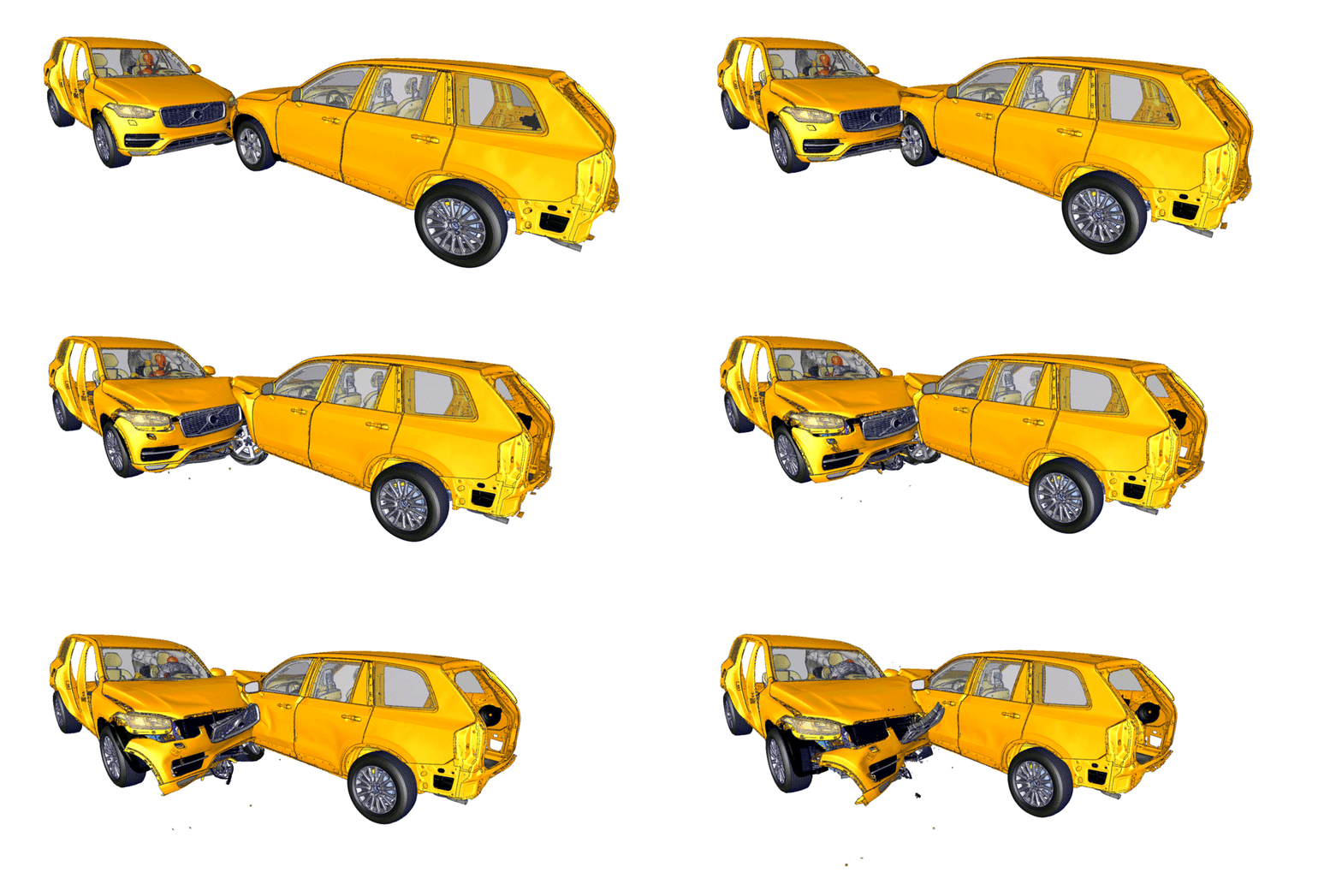
For many automotive companies LS-DYNA is an indispensable tool for to understanding the mechanisms in play during the deformation of such complex systems as a vehicle structure during crash.
LS-DYNA can be used to determine the behavior of a vehicle even before the fi rst prototype is built. In general far more crash scenarios can be investigated numerically than physical tests can be performed. Furthermore, the time to market is reduced signifi cantly by applying LS-DYNA during product development.
LS-DYNA is equipped with many features specifically designed for automotive applications e. g. spot welds, airbag models, seat belt models, and retractors. Currently more than 15 car manufacturers use LS-DYNA for crash applications and provide feedback and ideas to enhance the code. The majority of automotive features are developed on customer’s request. For instance three different analysis methods are available to investigate airbag deployments. These three methods address different approximation levels for the bags, the initial deployment can be analyzed in detail, in very high detail or only with the resolution required to predict the bag behavior of the unfolded airbag. Thus LS-DYNA can be used to analyze out-of-position situations, to design a turning baffle in a gas generator or to look at a stand interaction of occupant with an airbag.
Models of standard test devices, such as dummies and barriers, are available to facilitate the development process. Many common models are available freely for any LS-DYNA licensee. In addition a huge set of highly validated models are developed by third party user groups and are available to purchase.
Since failure and post-failure prediction plays an important role for crash applications the manufacturing history of the parts cannot be neglected. LS-DYNA is capable of analyzing a vast set of manufacturing processes and consequently this information can be integrated seamlessly.
Besides crash applications LS-DYNA is very well prepared to handle the dynamic and static load cases typically considered in the vehicle development process. With very few settings an existing model, initially prepared for a crash analysis, can be used to estimate the vehicle behavior during a roof crush, door sag, an abusive loading, or to determine the load distribution in a later fatigue analysis.
Additionally LS-DYNA is used to assess the robustness of the final product. As a result manufacturing tolerances can be determined selectively to guarantee product performance and to reduce the final cost.
LS-DYNA in Metal Forming
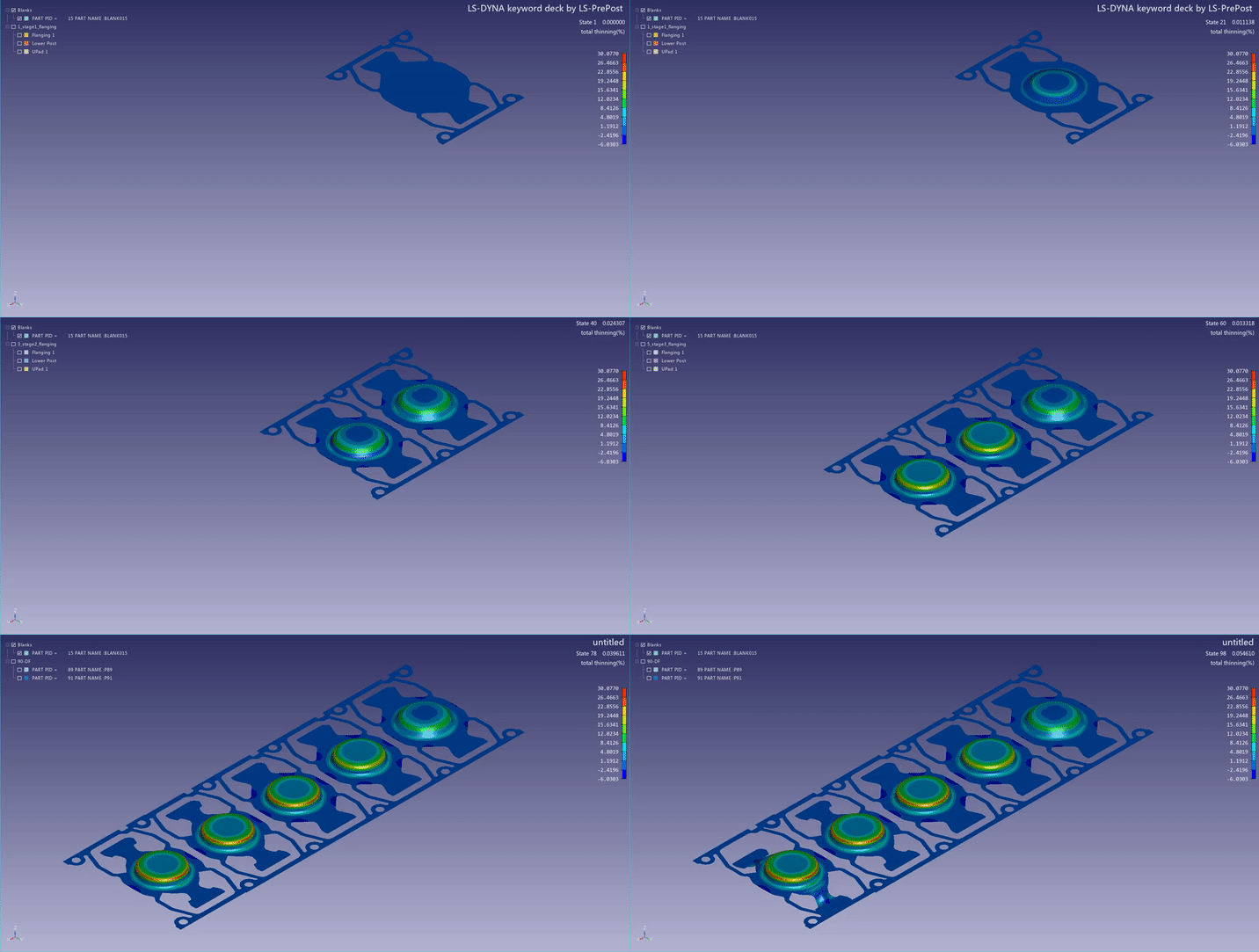
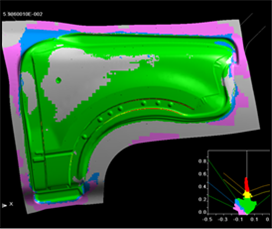
The main application of LS-DYNA in metal forming is sheet metal stamping. The incremental approach of LS-DYNA allows users to simulate multi-stage sheet metal stamping processes with high accuracy. Using the implemented multiple core technology the simulation time can be very short. As a result even large parts with very high accuracy requirements can be simulated within one hour; consequently the simulation of the forming process may be completed by the simulation of the trimming and the spring-back of the part.
The simulation may focus on different targets. One common target is determining the feasibility of the part in a forming process and its final geometry after the different stamping and following steps. Using this information the parameters of the process, the forming sequence and a optimal tool geometry, can be determined. As a result the part can be manufactured using less forming steps, with a more accurate shape and a better surface quality-which results in lower cost per part.
Another target might be the design of a hot forming process. The program enables one to determine metal phase transformations due to cooling. Heating due to heat flow and radiation before, during, and after the forming process can be analyzed. Thus the whole process, starting from heating followed by the forming and completed by the cooling, can be analyzed. One model can be used to predict the time needed for heating and cooling, the press requirements and the later part performance.
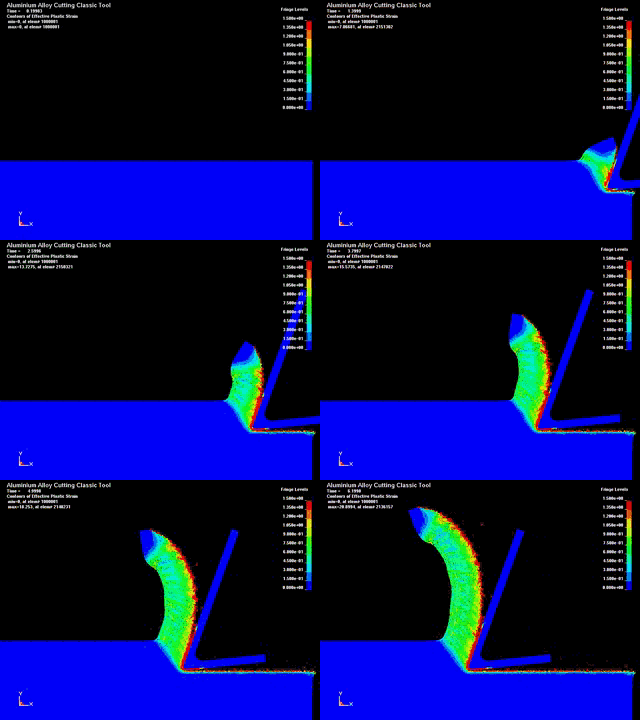
As well as sheet metal forming other metal forming applications including tube forming, cutting, extruding, impulse forming, forging, rolling, welding, hemming, flanging, electromagnetic forming, bending can also be analyzed effectively with LS-DYNA. For many of these applications different disciplines are coupled. Features like re-meshing, meshless methods, switching of time-stepping schemes, ALE, thermal capacities, rigid body dynamics, and others will be used simultaneously.
Many specific sheet metal stamping features are provided within LS-DYNA and the pre- and post-processing tool LS-PREPOST which is included in the software package. Additionally the solver LS-DYNA is integrated into various different forming simulation tools. These tools are provided by third party companies, who supply a very effective support for a specific forming application and localization. A one step solver is in preparation and will soon be available in the standard LS-DYNA version.
ANSYS will release its first metal stamping simulation software in January,2022. Ansys Forming enables early stage and detailed design configurations by allowing users to preset varying simulation needs, including feasibility, formability and springback prediction. Through this end-to-end workflow, engineers can perform the entire die process on a single platform, eliminate the need for physical testing, and enhance productivity and cost savings. Ansys Forming reaches optimum performance by maintaining predictive accuracy and speed.

LS-DYNA – a Multi-Purpose Program for Automotive Suppliers
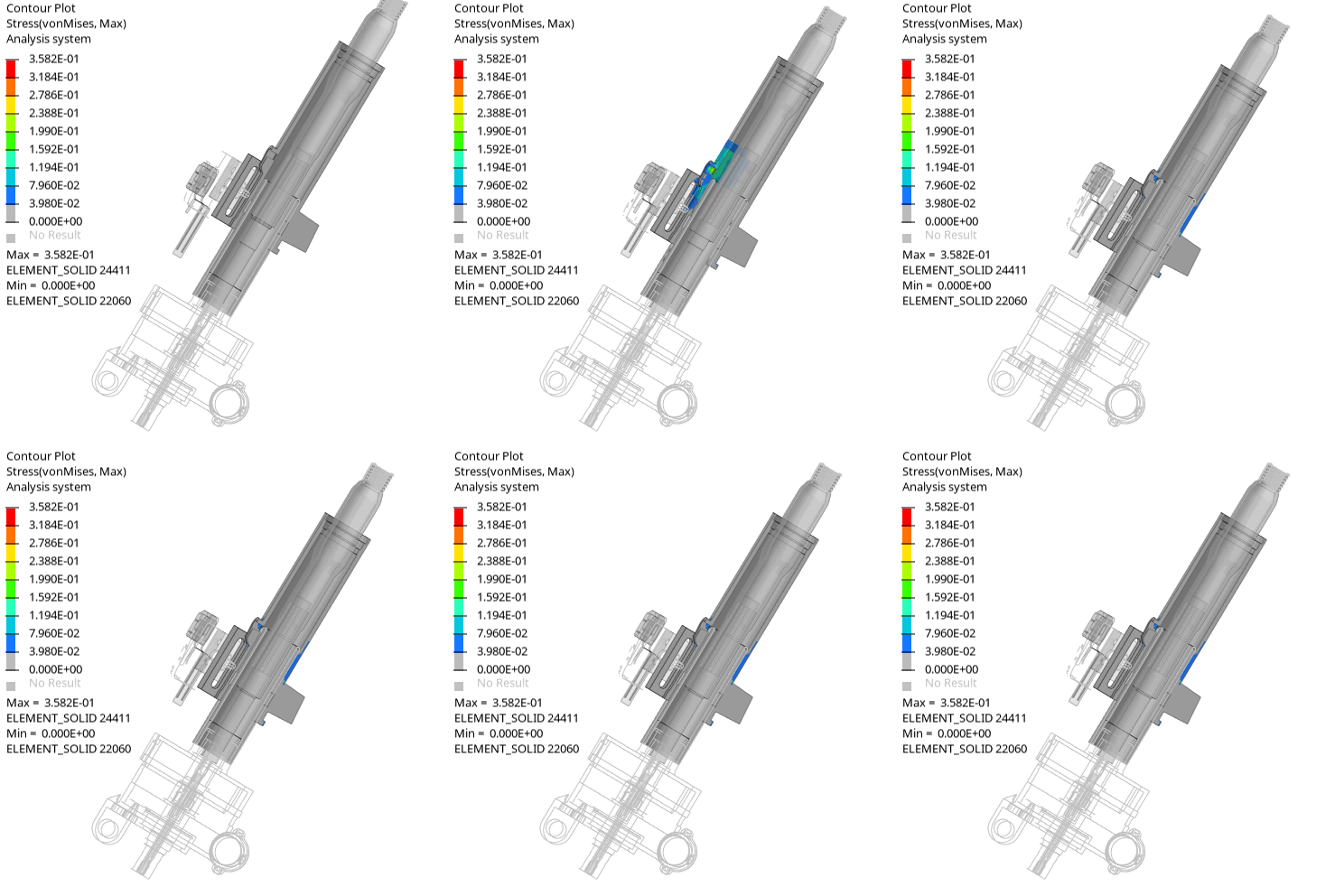
LS-DYNA allows for the virtual testing of many components used in vehicles. The explicit and implicit time stepping schemes are capable of simulating static and dynamic tests using the same model. Manufacturing of a part can be investigated by LS-DYNA using the metal forming and thermal capabilities. Hence only one model is required to address different problems. Ultimately, this results in lower costs for training and model creation compared to other solutions.
One area within which LS-DYNA can be harnessed beneficially is within applications in seat design. Seat manufacturers can consider the static and dynamic load cases for the seat frame; they can also analyze the stability of the belt anchorage points and use of LS-DYNA can enable them to determine maximal loads of locking mechanisms or failure loads of seat tracks.
The infl uence of the seat for the occupant in a crash can be investigated as well as the stamping process of a gear wheel. This user group often utilizes LS-OPT, a state of the art optimization tool, to enhance the design and to find a robust solution. Other examples for similar beneficial applications of LS-DYNA are in the design and manufacturing of crash boxes, bumpers, front ends, dashboards, trimmings, and tires.

LS-DYNA for Drop Test Analysis
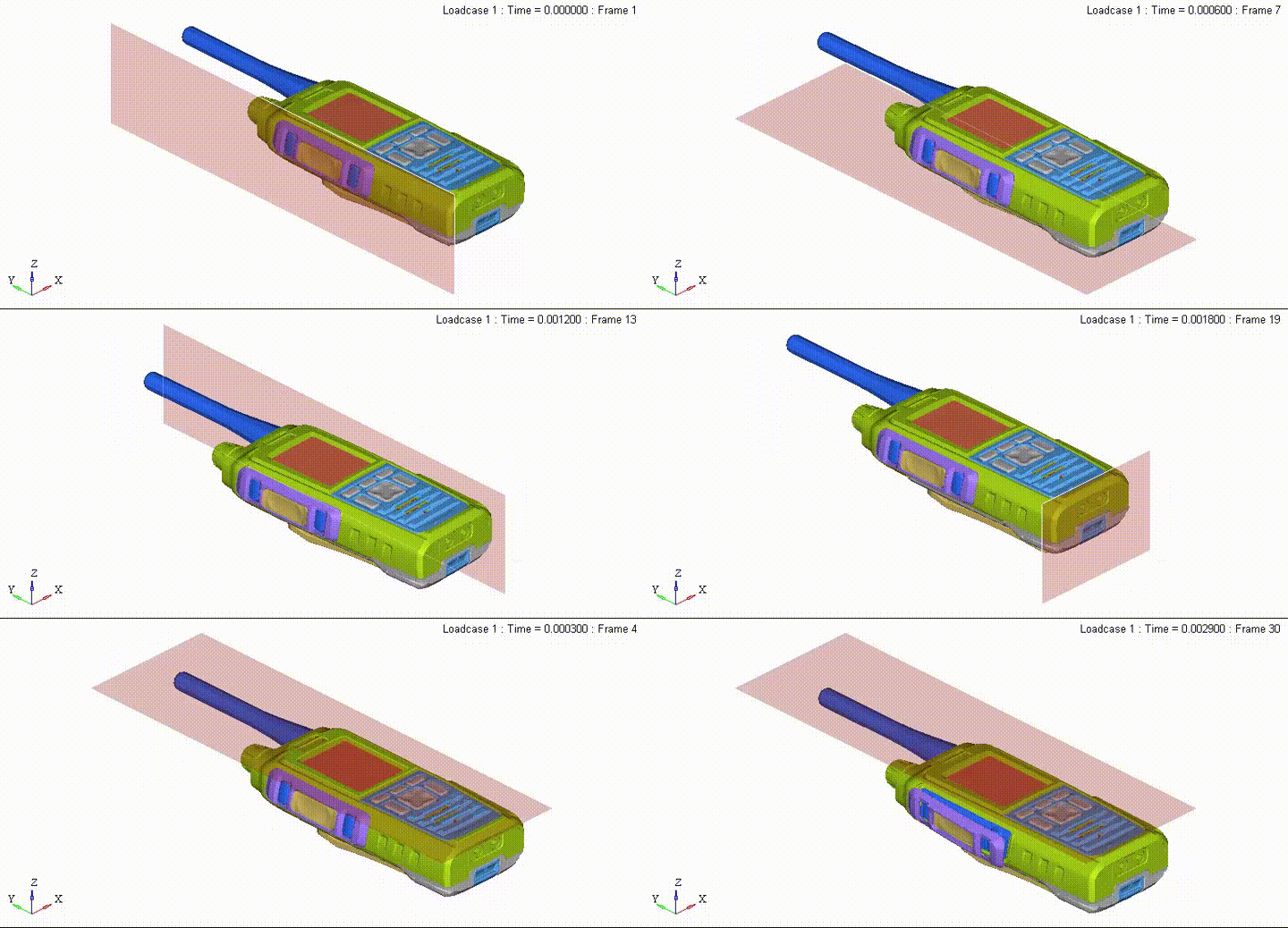
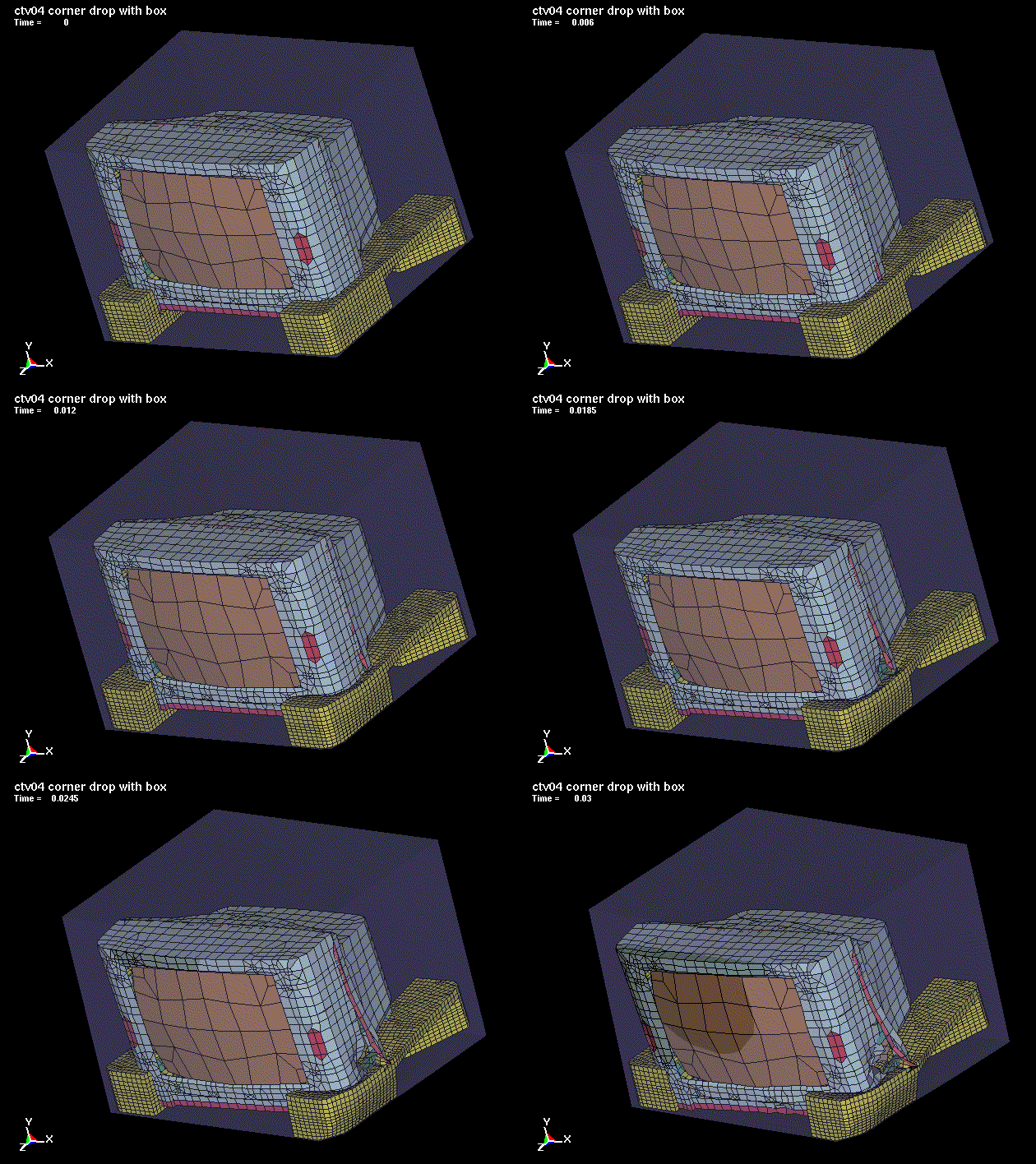
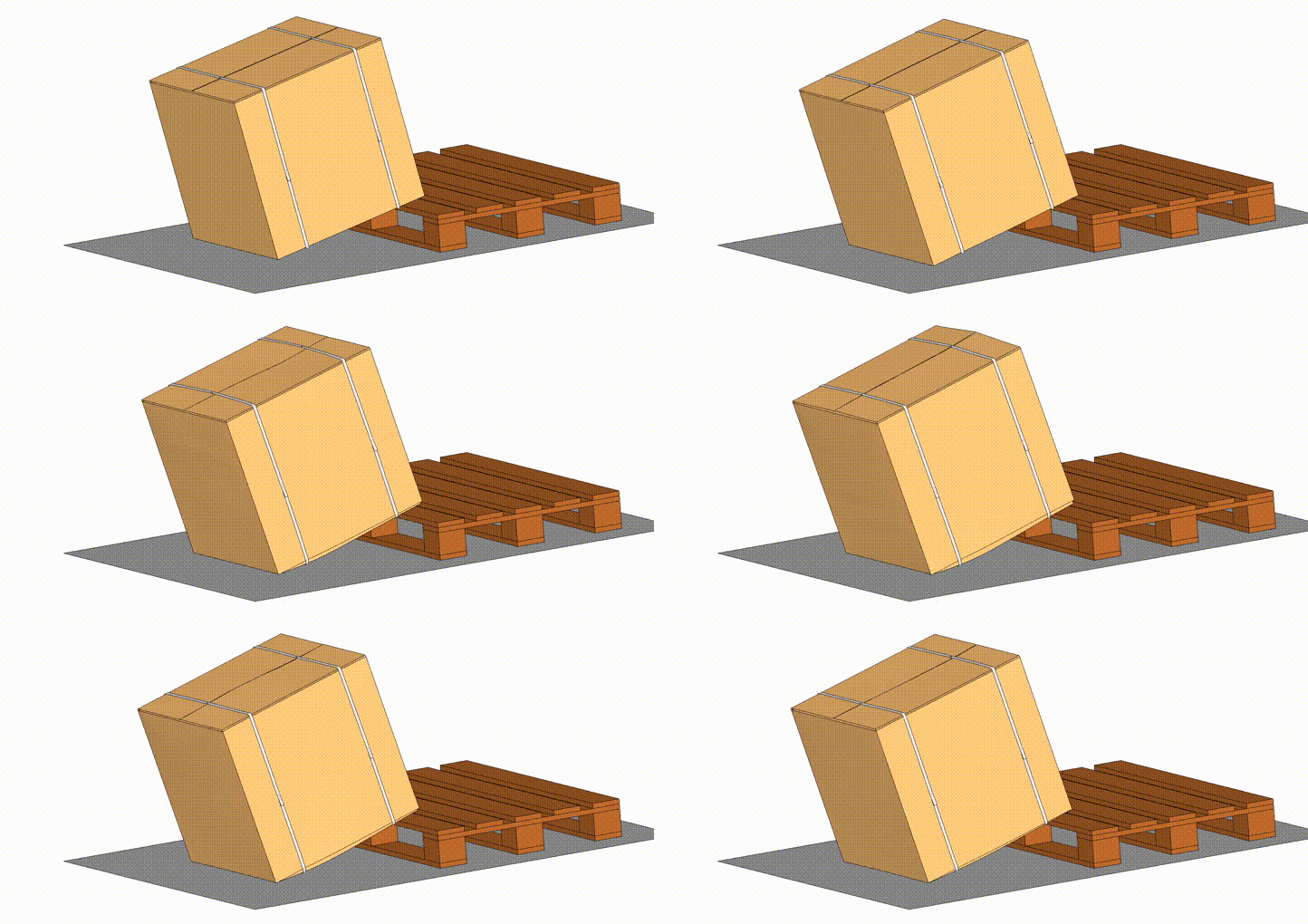
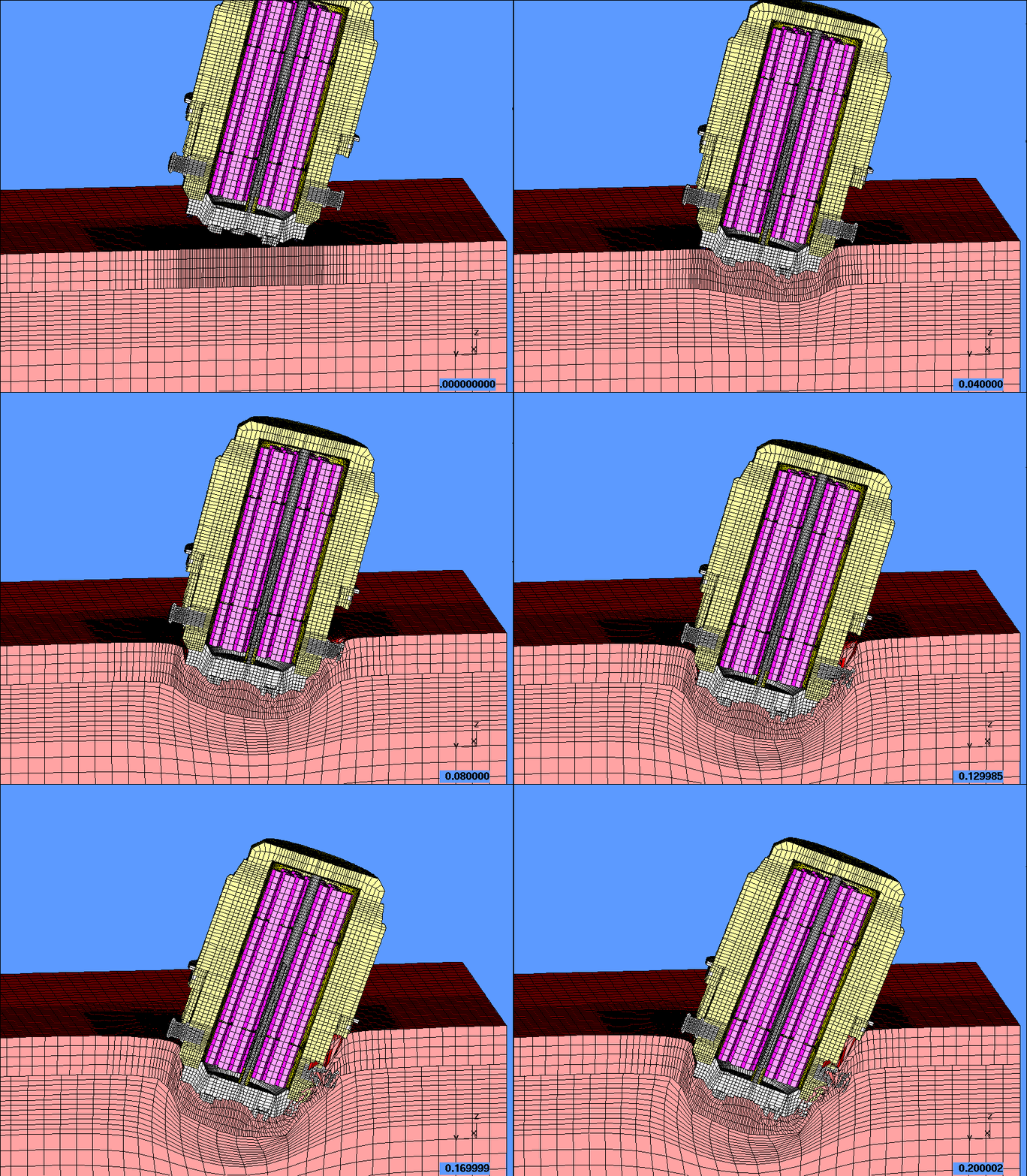
LS-DYNA can be used to investigate the behavior of products under impact loading conditions due to dropping. Consider the optimization of the durability of a toy or the analysis of the impact of a turbine blade on its housing. In the nuclear industry LS-DYNA assists in the design of containers that sustain possible dynamic loading during transportation or storage.
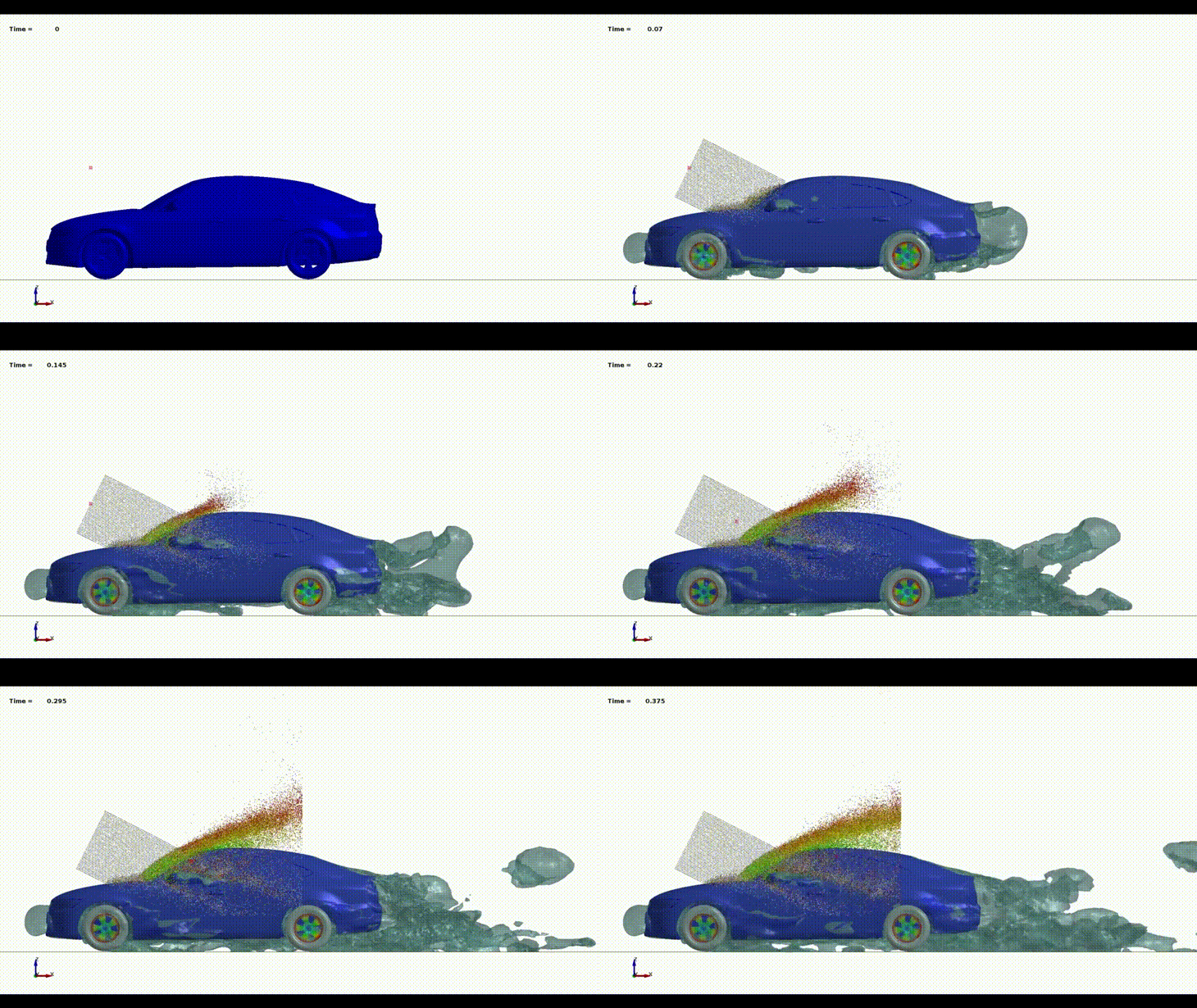
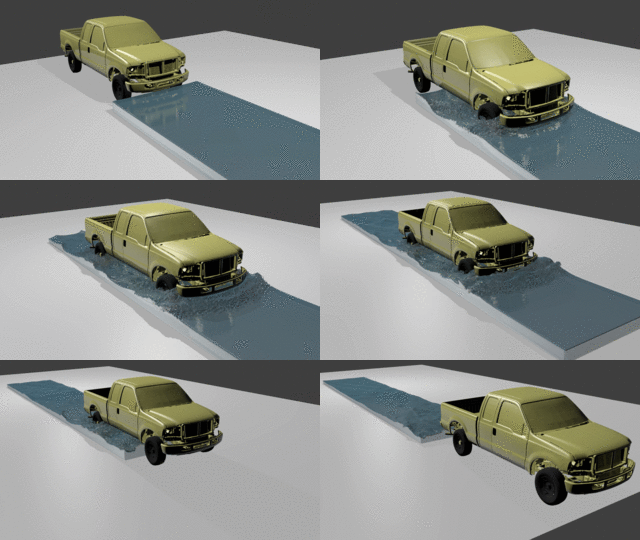
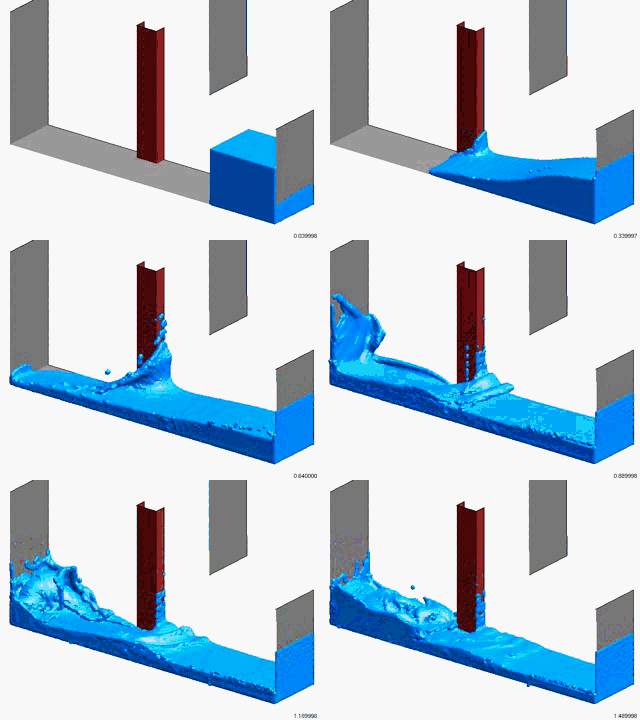
Besides the wide range of material models equipped with complex failure mechanisms the flexible coupling and switching capabilities of LS-DYNA are essential for many applications. For instance a liquid in a container can be modeled with the ALE or SPH Method coupled with the structure. This allows proper modeling of the liquid behavior during impact.
For investigating the crack itself the Element Free Galerkin (EFG) Method can be used to eliminate the mesh influence during crack propagation. To determine the steady state deformation effectively LS-DYNA provides the flexibility to switch the time stepping scheme arbitrarily between explicit and implicit. Furthermore LS-DYNA allows for switching parts from rigid to deformable and vice versa. Often this feature is used to determine the position of one part against another during a falling phase before main impact.
LS-DYNA for Containment
In some industries there is always the risk that accidents may cause severe damage to nature or communities. LS-DYNA acts as a tool to reduce these risks by generating knowledge of how a system may fail. Thus design changes can be made to reduce or even eliminate the risk for the considered load cases. One example is the transportation containers of nuclear fuel elements. In any predictable accident that might occur during transportation the opening and leaking of a container should be avoided.
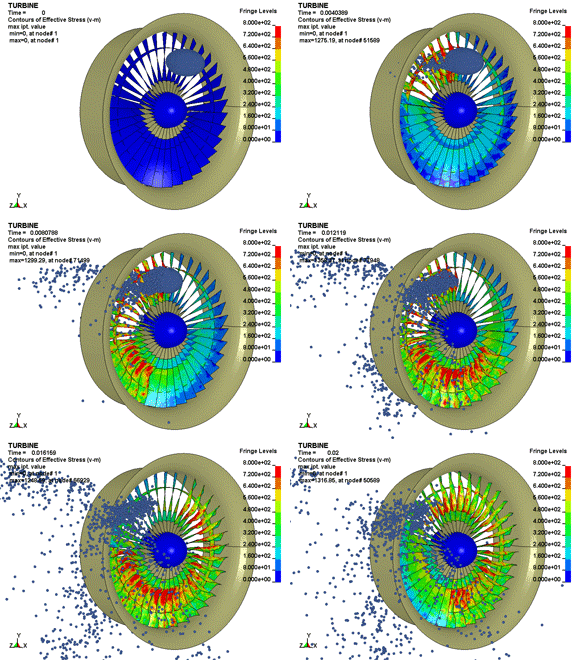
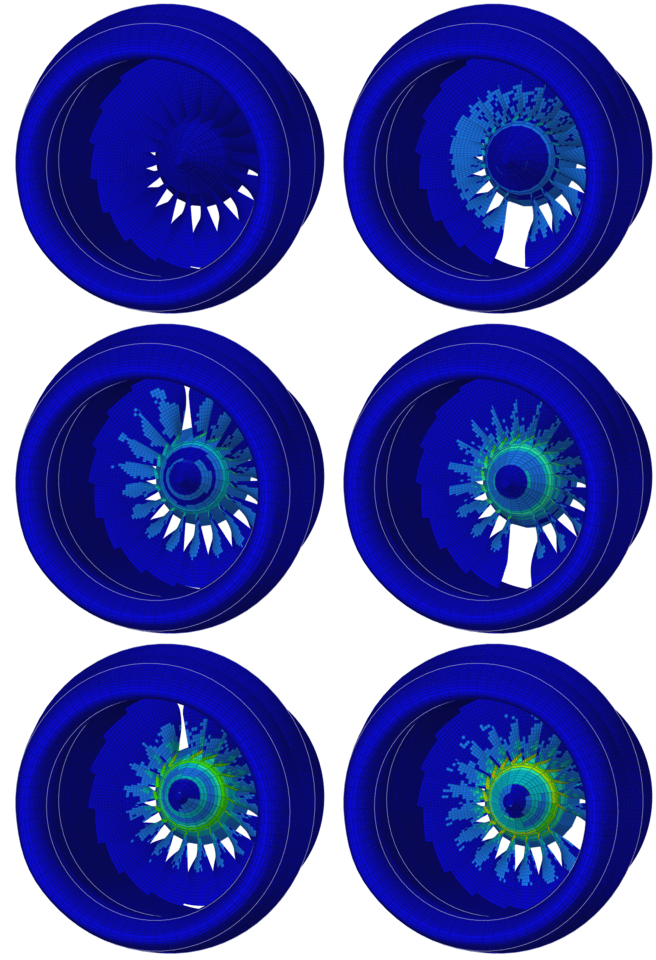
LS-DYNA is used to design the transport containers, its interior and the energy absorbing buffers at the enclosing hull of the containers. Other examples include the impact of parts that hit devices with a high speed. E.g. a turbine plate that separates from the turbine shall not be able to damage the embankment dam.
LS-DYNA enables users to estimate the damage caused if a turbine plate were to hit the turbine housing. As these types of simulation require an exact prediction of the post failing phase a huge effort in preliminary material testing is needed, however due to the high potential for severe damage this is effort well spent.
LS-DYNA for Manufacturing
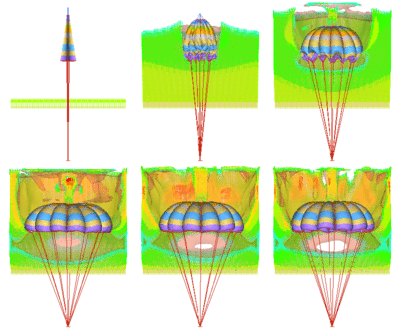
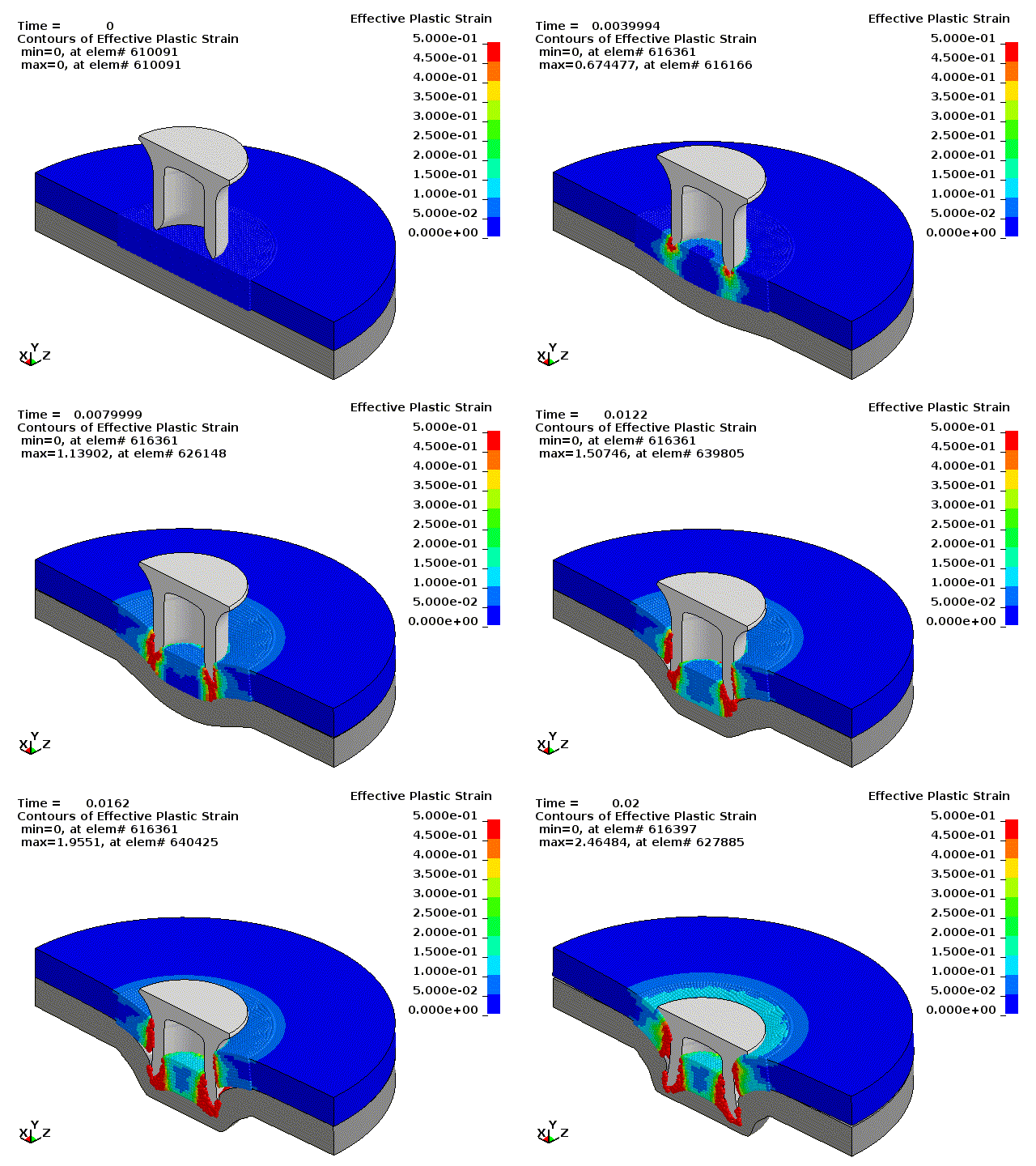
During manufacturing of commodities the reliability and speed of the production and packaging steps play a crucial role in determining product costs. Usually the fabrication process involves non-linear steps and uses different physical effects. The non-linear capabilities and the coupling of different numerical schemes make LS-DYNA a unique tool to find the answers occurring during layout of manufacturing processes.
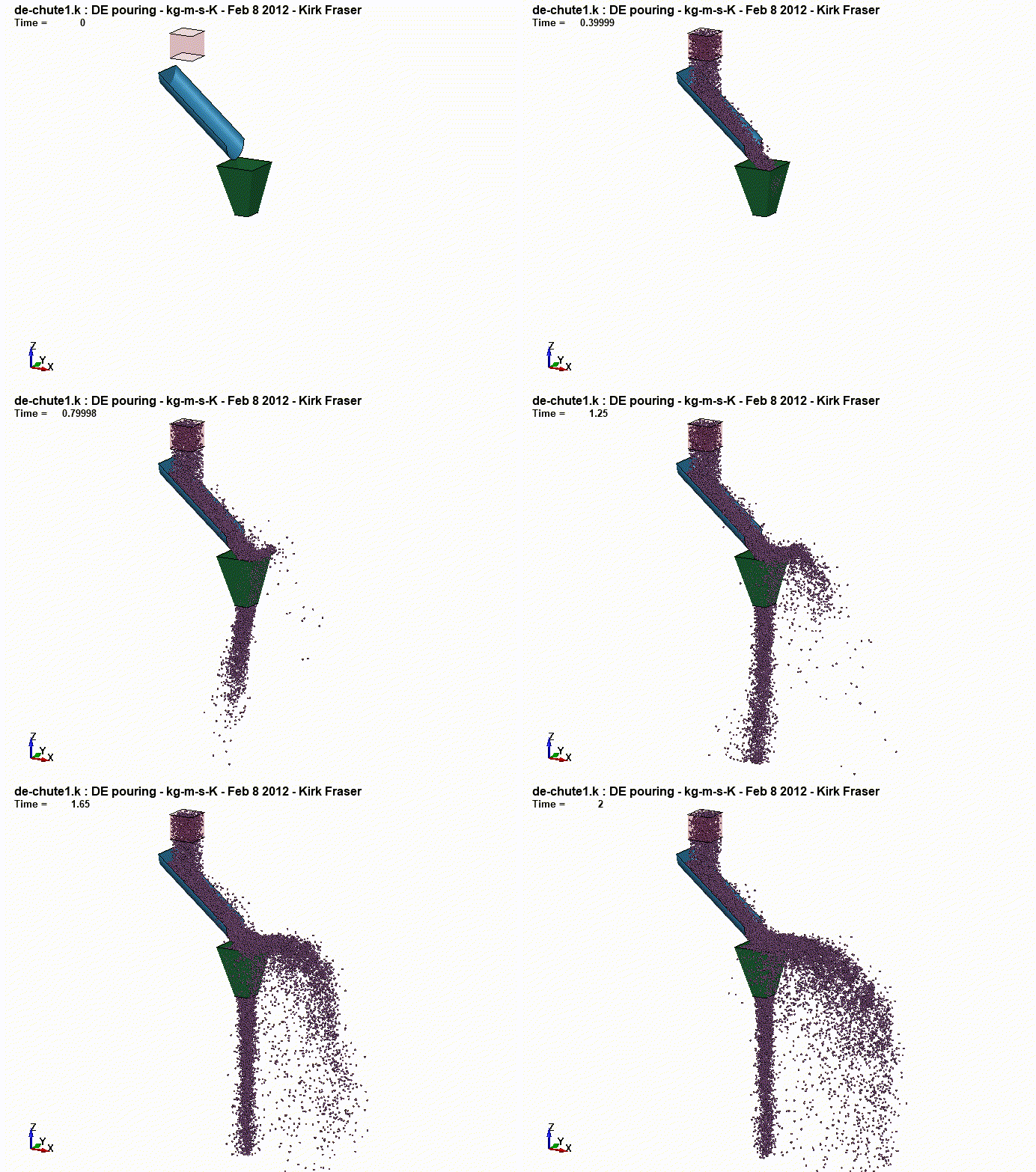
For instance the deformation of a container during filling, handling, closure, packaging and stacking can be investigated. The behavior of a snap fit can be analyzed in respect to the performance after a series of opening and closings, manufacturing tolerances or in respect to influences during handling or transportation. Other applications may include the folding of tissues and the packing of bulk or granular goods.
Due to the short development time for commodities in some cases the simulation is only used to understand the physically important parameters and their impact on the considered process, rather than an entirely verified simulation. As a result the manufacturing process can be improved to produce more parts in a shorter time with a higher quality and reliability. In this manner even small savings per part can add up to a huge total.
LS-DYNA for Research Applications
New technology is continuously being incorporated into LS-DYNA. For instance new methods like Element Free Galerkin (EFG), and Smooth Particle Hydrodynamics (SPH) are now available in LS-DYNA.
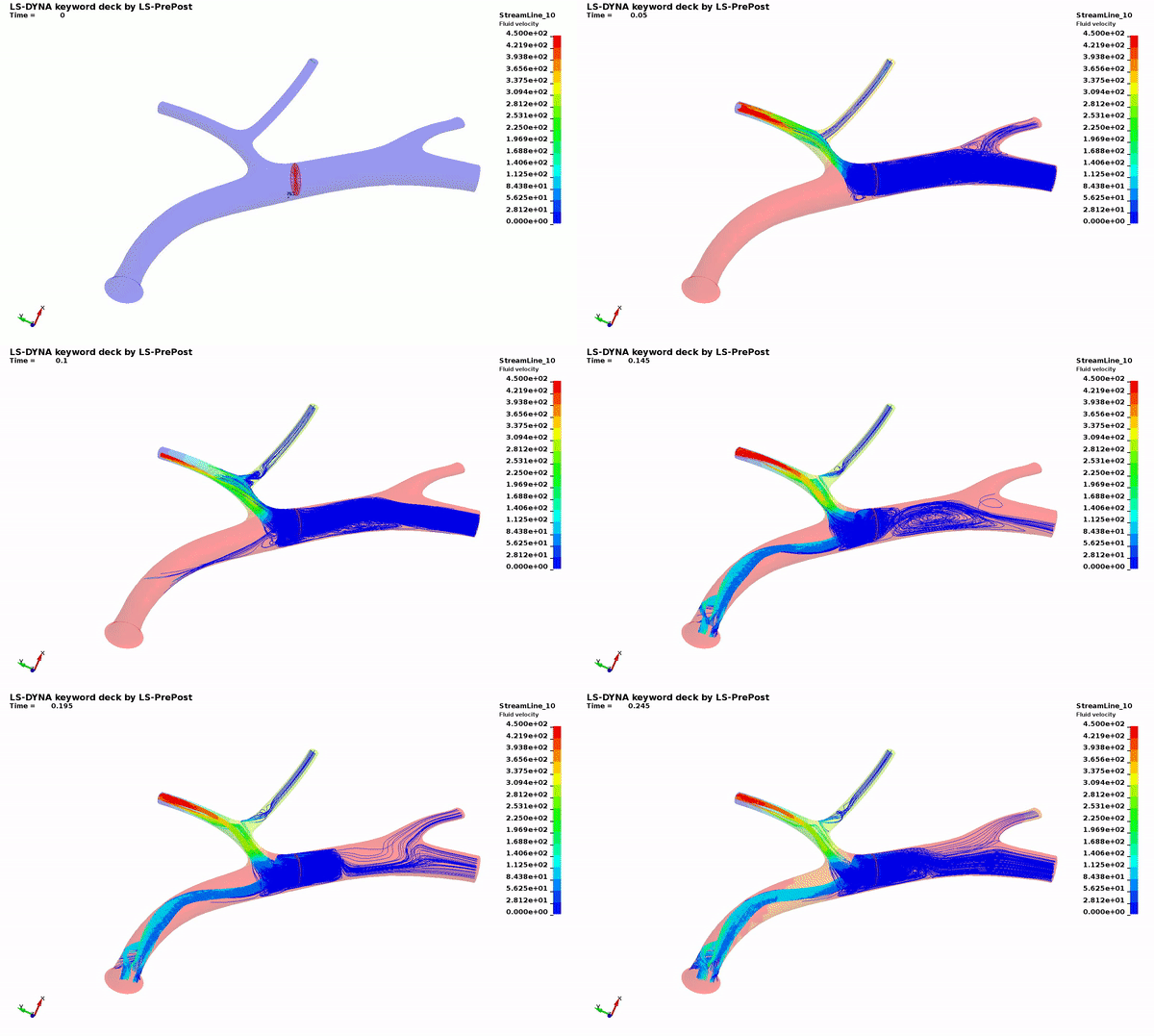
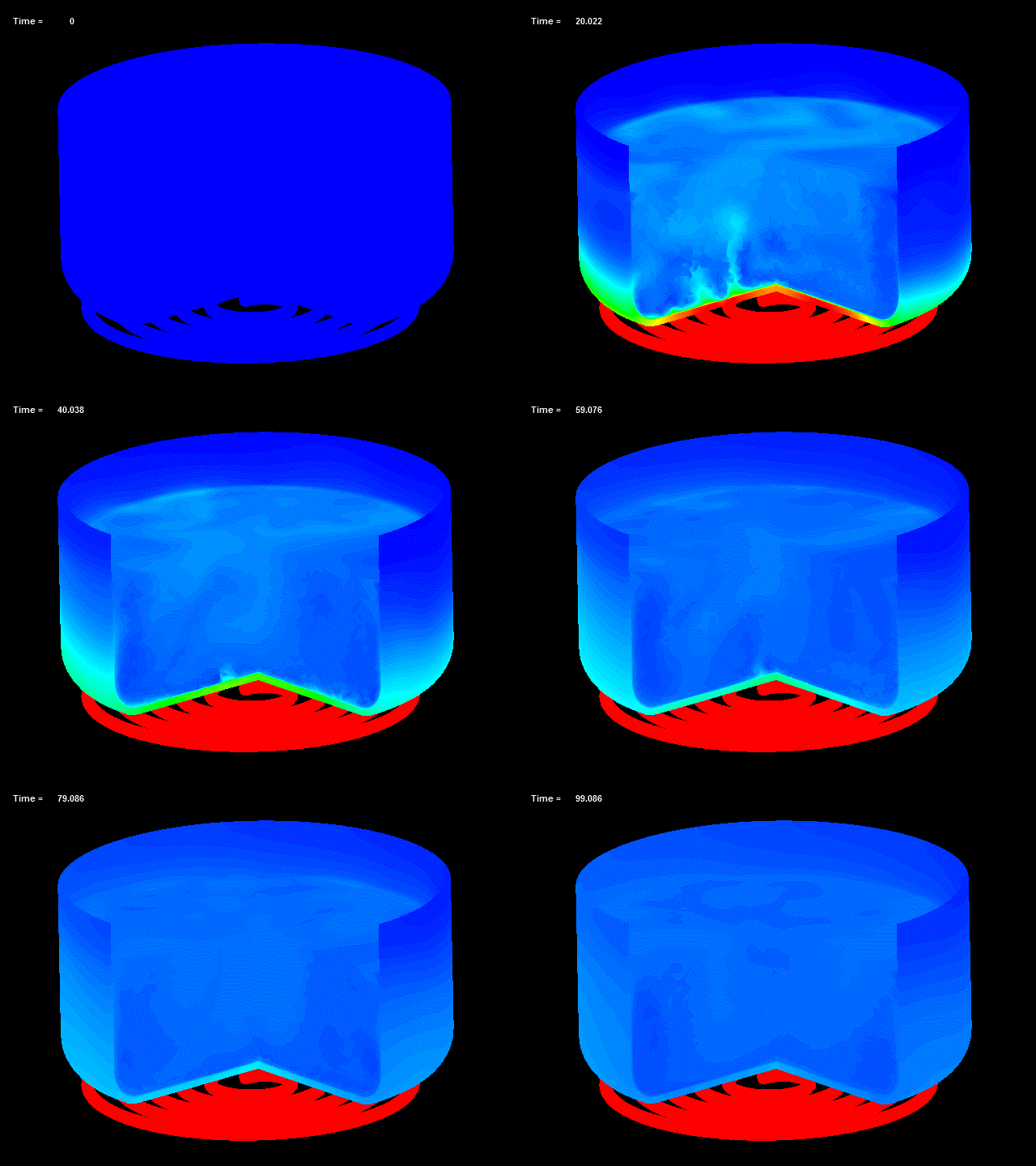
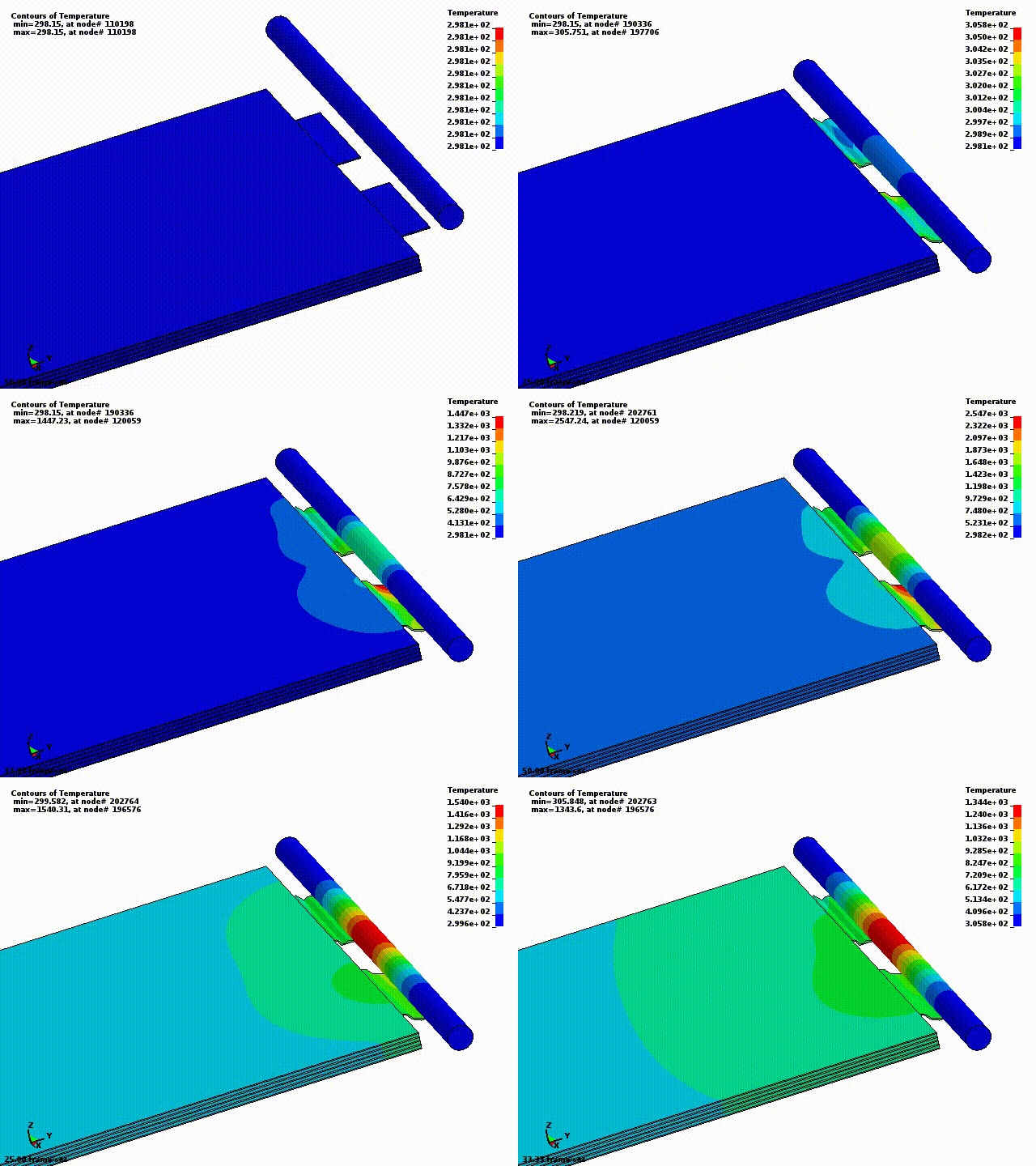
For many research applications the possibility of investigating multi-physics problems by coupling the different methods is important. For instance, Eulerian and Lagrangian formulations can interact in one simulation. Solutions for thermal analysis and computational fluid dynamics (CFD) or the boundary element method are provided in LS-DYNA. The development of new constitutive equations is facilitated by providing an interface that allows the incorporation of new material routines.
Detailed investigations of real world problems often require a huge amount of computational power. The excellent parallelization on MPP machines allows researchers to work with very detailed models whilst maintaining low hardware costs. LS-DYNA is extensively used in various research applications, one example is in the biomedical field. Here questions related to whiplash, bone fractures, and operating modes of heart valves or ankles are addressed. LSTC is very dedicated to providing LS-DYNA for educational purposes.
Main Application Areas
As a result of the wide range of features within LS-DYNA the software is employed in many different fields. A list of common applications is given below.
■ Crashworthiness simulations of automobiles, trains, ships
■ Emergency landings of airplanes
■ Occupant safety analysis
■ Pedestrian safety analysis
■ Automotive part manufacturing
- Car body
- Seats
- Roofs
- Doors
- Hoods
- Bumpers
- Crash boxes
- Girders
- Steering wheels
- Steering columns
- Dash boards
- Paddings
■ Metal forming
- Rolling
- Extrusion
- Forging
- Casting
- Spinning
- Ironing
- Superplastic forming
- Sheet metal stamping
- Profile rolling
- Deep drawing
- Hydroforming
- Multi-stage processes
- Springback
- Hemming
■ Metal cutting
■ Glass forming
■ Biomedical applications
■ Stability/failure investigations
- Cranes
- Seat tracks
■ Drop tests
- Consumer products
- Tools
- Nuclear vessels
■ Earthquake engineering
■ Bird strike
■ Jet engine blade containment
■ Penetration
■ Plastics, mold and blow forming
■ Blast loading
■ Spot-welded, riveted and bolted structures
■ Shipping containers
■ Can and container design
Analysis Capabilities
Different applications utilize one or a combination of the features listed below.
■ Nonlinear dynamics
■ Couples rigid body dynamics
■ Quasi-static simulations
■ Normal modes
■ Linear and non-linear static
■ Eigenvalue analysis
■ Thermal analysis
■ Fluid analysis
■ Eulerian capabilities
■ Arbitrary Lagrangian Eulerian (ALE)
■ Fluid-structure interactions
■ Underwater shock analysis coupling (USA)
■ Failure analysis
■ Crack propagation
■ Real-time acoustics
■ Multi-physics coupling
■ Structural-thermal coupling
■ Adaptive re-meshing
■ Rezoning
■ Smooth particle hydrodynamics (SPH)
■ Element free methods (EFG)
■ X-FEM
■ CSE solver
■ 2D and 3D formulations
■ Nastran reader
■ Arbitrary rigid to deformable switching
■ Arbitrary implicit to explicit switching
■ Dynamic relaxation
Library of Material Models
LS-DYNA provides more than 130 metallic and non-metallic material models, many of them equipped with failure criteria. Frequently used modeled materials are:
■ Metals
■ Plastics
■ Visco-elastic
■ Elasto-viscoplastic
■ Glass
■ Foams
■ Fabrics
■ Elastomers and rubbers
■ Honeycombs
■ Composites
■ Concrete and soils
■ High explosives
■ Propellants
■ Viscous fluids
■ Biomedical models
■ User-defi ned materials
Large Element Library
LS-DYNA has an extensive element library with both under-integrated and fully-integrated element formulations. The lower-order finite elements in LS-DYNA are accurate, efficient, and robust. For the under-integrated shell and solid elements zero-energy modes are controlled by either viscosity or stiffness hourglass control formulations.
■ Different solid elements
■ 8-node thick shells
■ Different 3- and 4-node shells
■ Beams
■ Welds
■ Discrete zero length beams
■ Trusses and cables
■ Nodal masses
■ Lumped inertias
■ Arbitrary Lagrangian/Eulerian elements
■ Eulerian elements
■ Element Free Galerkin formulations
■ SPH elements
■ Elements for 2D-analysis
■ User-defi ned elements
Contact Algorithms
Constraint and penalty techniques have worked extremely well over the past 20 years in numerous applications. Coupled thermo-mechanical contact can also be handled. Over 25 different contact options are available. These options primarily treat contact of deformable to deformable bodies, single surface contact in deformable bodies and deformable or rigid to rigid body contact. Multiple definitions of contact surfaces are possible as outlined below.
■ Single surface contact
■ Contact with rigid walls
■ Edge-edge contact
■ Beam-beam contact
■ Eroding contact
■ Contact with CAD surfaces
■ Tied surfaces
■ 2D-contact
■ Shell edges tied to shell surfaces
■ Resultant force contact
■ Fluid-structure interfaces
■ Pinball contact
■ Friction models:
- Static and dynamic coulomb
- Viscous friction
- Pressure dependent friction
- User-defined friction models
Rigid Body Dynamic Features
Many features used in multi-body applications are also provided in LS-DYNA. A selected set of features is listed below.
■ Rigid bodies
■ Rigid to deformable switching
■ Deformable to rigid switching
■ Joints
- Spherical joint
- Revolute joint
- Cylindrical joint
- Translational joint
- Locking joint
- Motor joint
- Pulley and screw joints
- Cardan joint
- Flexion/torsion joint
■ Contact
- Rigid body to deformable body contact
- Rigid body to rigid body contact
■ Multiple discrete elements (granular)
Platforms
LS-DYNA is ported to all common platforms. Massive Parallel Versions (MPP – Message Passing Programming), Shared Memory Version (SMP – Symmetric Memory Processing) and a Hybrid Version (SMP on a CPU and MPP across the CPUs) are available as well as single and double precision versions. Detailed information on the availability for the required platform and operation system is available from your local distributor.
Specialized Metal Forming Features
Specific features developed in LS-DYNA enable the handling of simulations in metal forming. These feature are tailored to achieve accurate results efficiently.
■ IGES/VDA-contact
■ Rigid tooling
■ Thermal contact
■ 2D re-meshing and remapping
■ Implicit springback
■ Trimming
■ Adaptive mesh refi nement
■ Mesh coarsening
■ Look ahead adaptivity
■ Analytic drawbeads
■ Complex sliding algorithms
■ Anisotropic plasticity (Hill, Barlat)
Specialized Automotive Features
LS-DYNA provides many features developed as a result of specific requirements within automotive applications. A selection of features is listed below.
■ Seatbelt
■ Slip ring
■ Pretensioner
■ Retractor
■ Sensor
■ Accelerometer
■ Airbag reference geometry
■ Inflator models
■ Uniform pressure model for airbag simulation
■ Corpuscular method for out-of-position simulations
■ ALE method for out-of-position simulations
■ MADYMO-coupling
Models for Automotive Applications
Finite element models for almost all standard parts in automotive testing are available as already prepared input files. Depending upon the requirements different levels of details and different degrees of validation are available. The parts are often third party products and come usually with software support from your local distributor. LSTC makes a conscious effort to provide free basic models for frequently used dummies and barriers. These models are available to all LS-DYNA licensees. Please find a list of the current types of models available below.
■ Hybrid III dummies
■ SID-IIs dummy
■ P and Q child dummies
■ USSID dummy
■ Eurosid dummy
■ ES-2 dummy
■ ES-2re dummy
■ BioRID dummy
■ WorldSID dummies
■ Different head forms
■ Pedestrian impactors
■ THOR-NT dummy
■ Human models
■ NHTSA barriers
■ NCAP barriers
■ IIHS barrier
■ ECE barriers
■ Euro-NCAP barrier
■ Simple vehicle models
■ Roadside models
LS-OPT
LS-OPT is a graphical optimization tool which interfaces perfectly with LS-DYNA allowing the user to structure the design process, explore the design space and compute optimal designs according to specified constraints and objectives. The program is also highly suited to the solution of system identification problems and stochastic analysis.
Optimization
■ Response surface technologies
■ Genetic algorithm
■ Multidisciplinary optimization (MDO)
■ Multi-objective optimization (MOO)
■ Reliability based design optimization (RBDO)
■ Mixed discrete/continuous variables
■ Shape optimization
DOE Studies – Design Exploration
■ Design of experiments (DOE)
■ Meta-models to explore design space
■ Global sensitivity analysis
System Identification
■ Identification of system/material parameters
■ Visualization of fitting history for curves
Stochastic Analysis
■ Monte Carlo investigations
■ Estimation of mean, standard deviation, correlation
■ Reliability studies (FOSM, FORM)
■ Visualization of statistical results on the FE model
Postprocessing
■ Meta-model visualization (2D/3D)
■ Sensitivities, correlation matrix
■ Scatter/history plots
■ Pareto optimal solutions
LS-TaSC
This tool is for the topology optimization of non-linear problems involving dynamic loads and contact conditions. It can be used to find a concept design for structures analyzed using LS-DYNA.
General capabilities
■ Solid design using hexa and tetra elements
■ Shell design using quad and triangular elements
■ Global constraints
Geometry defi nitions
■ Multiple parts
■ Constraints: extrusions, casting, symmetry
LS-PREPOST
LS-PrePost specializes in importing, editing, and exporting LS-DYNA models, based on keyword input files. Version 3.0 features a redesigned graphical user interface that maximizes the graphics area by intuitively grouping program functions into icon-based toolbars. LS-PrePost supports the latest OpenGL standards to provide fast rendering for fringe plots and animation results. The software is under constant development to keep pace with enhancements to LS-DYNA and, since no license file is required, LS-PrePost can be easily installed on any machine running Windows or Linux.
General Features
■ Comprehensive support for LS-DYNA input and output files
■ Image output formats: PNG, TIFF, JPG, BMP, PCX, PS, PSIMAGE, GIF, VRML2
■ Movie output formats: MPEG, AVI, animated GIF
■ Command line interface
Pre-Processing Features
■ Other FE input formats
■ CAD input formats: IGES, STEP
■ CAD geometry data creation and manipulation, including cleaning, healing and simplification
■ Mesh generation
■ Mesh manipulation, creation, and modification
■ LS-DYNA entity (keyword) creation: coordinate systems, sets, parts, masses, CNRBs, boxes, spot welds, SPC‘s, rigidwalls, rivets, initial velocity, accelerometers, cross sections
Special Applications
■ Airbag folding
■ Dummy positioning
■ Seatbelt fi tting
■ Metal forming
■ Roller hemming
■ Model checking
Post-Processing Features
■ 3D animation
■ Time history plots
■ XY plots
■ Contour plots
■ Overlay plots
■ Vector plots
■ Fringe plots
■ Particle visualization
■ Fluid visualization
■ DYNAIN file generation
■ Section analysis
Websites
In addition to the information supplied by your distributor and the support hot-line a substantial amount of information is available on the internet. Technical papers, FAQs, HowTos, tutorials, models, examples, manuals, and detailed descriptions can be found at the URLs below. All sites are accessible without login.
■ www.lstc.com
The website of the code developer LSTC.
■ www.feainformation.com
Site with general information and avi library of different simulations.
■ www.dynasupport.com
The official support site of LS-DYNA. Here you find tutorials, FAQs, release notes of LS-DYNA and manuals availalbe to download.
■ www.lsoptsupport.com
The official support site of LS-OPT. Users may find news, HowTos, FAQs, examples on LS-OPT.
■ www.dynalook.com
This site contains technical papers from International and European LS-DYNA Conferences from the last 10 years. More than 950 papers are available.
■ www.dynaexamples.com
Here users can download class notes and examples of different LS-DYNA training classes.
■ www.topcrunch.org
Benchmark results of LS-DYNA on different hardware platforms are available at this site. This information can be used to access and compare the performance of hardware.
■ blog.d3view.com
Various comments and details on LS-DYNA features can be accessed at this site.
■ www.ncac.gwu.edu/vml/models.html
This site is maintained by the NCAC. It provides finite element models for various vehicles and road side structures.
■ www.dummymodels.com
Here LS-DYNA dummy models are presented and details are available on their validation level.
Additionally, users may join a user group like:
■ http://tech.dir.groups.yahoo.com/group/LS-DYNA/
■ http://groups.google.com/group/lsopt_user_group
Note: all pictures or videos on this website are from the Internet or the data files of ANSYS LST company. If there is infringement, please inform and will be deleted and replaced.
For more details information and purchase of the model, please contact Shanghai Dynawe Information Technology Co., Ltd.: Zhao Haiou, Tel.: 13816888516, email: Stephen zhao@dynawe.com
Introduction
LS-DYNA is a highly advanced general purpose nonlinear finite element program that is capable of simulating complex real world problems. The distributed and shared memory solver provides very short turnaround time on desktop computers and clusters running under Linux, Windows, and Unix. The major development goal of Livermore Software Technology Corporation (LSTC) is to provide, through LS-DYNA, capabilities to seamlessly solve problems that require "Multi-Physics", "Multi-Processing", "Multiple Stages", "Multi-Scale".
LS-DYNA is suitable to investigate phenomena that involve large deformations, sophisticated material models and complex contact conditions for structural dynamics problems. LS-DYNA allows switching between explicit and different implicit time stepping schemes. Disparate disciplines such as coupled thermal analyses, computational fluid dynamics (CFD), fluid-structure interaction, smooth particle hydrodynamics (SPH), element free Galerkin (EFG), corpuscular method (CPM), and the boundary method (BEM) can be combined with structural dynamics.
For many products LS-DYNA is key in reducing the time to market by determining the product characteristics before a prototype is build. Undertaking investigations using LS-DYNA helps to design robust products with superior performance. LS-DYNA is supplied with a tool called LS-PrePost for Pre- and Postprocessing. LS-PrePost can be utilized to generate inputs and to visualize the numerical results. Furthermore, the software package LS-OPT for optimization and robust design is also supplied with LS-DYNA. With the option of multidisciplinary simulations LS-DYNA increases the potential for developing innovative products significantly. All these advantages help to reduce development costs. All above mentioned features and software packages come as one unit. LS-DYNA is not split for special applications; the different disciplines can be combined without limitations as a result of the licensing scheme.
LS-DYNA has been developed in California for more than 20 years. It is the most frequently used code for many complex applications in structural nonlinear dynamics and the usage is continuously growing rapidly due to LS-DYNA’s flexibility to be applied to new disciplines. The new developments are driven in co-operation with leading Univesities from all over the world and new requirements requested by the vast customer base.
In 2019, ANSYS acquired LSTC company, and LS-DYNA software became a member of the ANSYS software family.
LS-DYNA to Design Vehicles
For many automotive companies LS-DYNA is an indispensable tool for to understanding the mechanisms in play during the deformation of such complex systems as a vehicle structure during crash.
LS-DYNA can be used to determine the behavior of a vehicle even before the fi rst prototype is built. In general far more crash scenarios can be investigated numerically than physical tests can be performed. Furthermore, the time to market is reduced signifi cantly by applying LS-DYNA during product development.
LS-DYNA is equipped with many features specifically designed for automotive applications e. g. spot welds, airbag models, seat belt models, and retractors. Currently more than 15 car manufacturers use LS-DYNA for crash applications and provide feedback and ideas to enhance the code. The majority of automotive features are developed on customer’s request. For instance three different analysis methods are available to investigate airbag deployments. These three methods address different approximation levels for the bags, the initial deployment can be analyzed in detail, in very high detail or only with the resolution required to predict the bag behavior of the unfolded airbag. Thus LS-DYNA can be used to analyze out-of-position situations, to design a turning baffle in a gas generator or to look at a stand interaction of occupant with an airbag.
Models of standard test devices, such as dummies and barriers, are available to facilitate the development process. Many common models are available freely for any LS-DYNA licensee. In addition a huge set of highly validated models are developed by third party user groups and are available to purchase.
Since failure and post-failure prediction plays an important role for crash applications the manufacturing history of the parts cannot be neglected. LS-DYNA is capable of analyzing a vast set of manufacturing processes and consequently this information can be integrated seamlessly.
Besides crash applications LS-DYNA is very well prepared to handle the dynamic and static load cases typically considered in the vehicle development process. With very few settings an existing model, initially prepared for a crash analysis, can be used to estimate the vehicle behavior during a roof crush, door sag, an abusive loading, or to determine the load distribution in a later fatigue analysis.
Additionally LS-DYNA is used to assess the robustness of the final product. As a result manufacturing tolerances can be determined selectively to guarantee product performance and to reduce the final cost.
LS-DYNA in Metal Forming
The main application of LS-DYNA in metal forming is sheet metal stamping. The incremental approach of LS-DYNA allows users to simulate multi-stage sheet metal stamping processes with high accuracy. Using the implemented multiple core technology the simulation time can be very short. As a result even large parts with very high accuracy requirements can be simulated within one hour; consequently the simulation of the forming process may be completed by the simulation of the trimming and the spring-back of the part.
The simulation may focus on different targets. One common target is determining the feasibility of the part in a forming process and its final geometry after the different stamping and following steps. Using this information the parameters of the process, the forming sequence and a optimal tool geometry, can be determined. As a result the part can be manufactured using less forming steps, with a more accurate shape and a better surface quality-which results in lower cost per part.
Another target might be the design of a hot forming process. The program enables one to determine metal phase transformations due to cooling. Heating due to heat flow and radiation before, during, and after the forming process can be analyzed. Thus the whole process, starting from heating followed by the forming and completed by the cooling, can be analyzed. One model can be used to predict the time needed for heating and cooling, the press requirements and the later part performance.
As well as sheet metal forming other metal forming applications including tube forming, cutting, extruding, impulse forming, forging, rolling, welding, hemming, flanging, electromagnetic forming, bending can also be analyzed effectively with LS-DYNA. For many of these applications different disciplines are coupled. Features like re-meshing, meshless methods, switching of time-stepping schemes, ALE, thermal capacities, rigid body dynamics, and others will be used simultaneously.
Many specific sheet metal stamping features are provided within LS-DYNA and the pre- and post-processing tool LS-PREPOST which is included in the software package. Additionally the solver LS-DYNA is integrated into various different forming simulation tools. These tools are provided by third party companies, who supply a very effective support for a specific forming application and localization. A one step solver is in preparation and will soon be available in the standard LS-DYNA version.
ANSYS will release its first metal stamping simulation software in January,2022. Ansys Forming enables early stage and detailed design configurations by allowing users to preset varying simulation needs, including feasibility, formability and springback prediction. Through this end-to-end workflow, engineers can perform the entire die process on a single platform, eliminate the need for physical testing, and enhance productivity and cost savings. Ansys Forming reaches optimum performance by maintaining predictive accuracy and speed.
LS-DYNA – a Multi-Purpose Program for Automotive Suppliers
LS-DYNA allows for the virtual testing of many components used in vehicles. The explicit and implicit time stepping schemes are capable of simulating static and dynamic tests using the same model. Manufacturing of a part can be investigated by LS-DYNA using the metal forming and thermal capabilities. Hence only one model is required to address different problems. Ultimately, this results in lower costs for training and model creation compared to other solutions.
One area within which LS-DYNA can be harnessed beneficially is within applications in seat design. Seat manufacturers can consider the static and dynamic load cases for the seat frame; they can also analyze the stability of the belt anchorage points and use of LS-DYNA can enable them to determine maximal loads of locking mechanisms or failure loads of seat tracks.
The infl uence of the seat for the occupant in a crash can be investigated as well as the stamping process of a gear wheel. This user group often utilizes LS-OPT, a state of the art optimization tool, to enhance the design and to find a robust solution. Other examples for similar beneficial applications of LS-DYNA are in the design and manufacturing of crash boxes, bumpers, front ends, dashboards, trimmings, and tires.
LS-DYNA for Drop Test Analysis
LS-DYNA can be used to investigate the behavior of products under impact loading conditions due to dropping. Consider the optimization of the durability of a toy or the analysis of the impact of a turbine blade on its housing. In the nuclear industry LS-DYNA assists in the design of containers that sustain possible dynamic loading during transportation or storage.
Besides the wide range of material models equipped with complex failure mechanisms the flexible coupling and switching capabilities of LS-DYNA are essential for many applications. For instance a liquid in a container can be modeled with the ALE or SPH Method coupled with the structure. This allows proper modeling of the liquid behavior during impact.
For investigating the crack itself the Element Free Galerkin (EFG) Method can be used to eliminate the mesh influence during crack propagation. To determine the steady state deformation effectively LS-DYNA provides the flexibility to switch the time stepping scheme arbitrarily between explicit and implicit. Furthermore LS-DYNA allows for switching parts from rigid to deformable and vice versa. Often this feature is used to determine the position of one part against another during a falling phase before main impact.
LS-DYNA for Containment
In some industries there is always the risk that accidents may cause severe damage to nature or communities. LS-DYNA acts as a tool to reduce these risks by generating knowledge of how a system may fail. Thus design changes can be made to reduce or even eliminate the risk for the considered load cases. One example is the transportation containers of nuclear fuel elements. In any predictable accident that might occur during transportation the opening and leaking of a container should be avoided.
LS-DYNA is used to design the transport containers, its interior and the energy absorbing buffers at the enclosing hull of the containers. Other examples include the impact of parts that hit devices with a high speed. E.g. a turbine plate that separates from the turbine shall not be able to damage the embankment dam.
LS-DYNA enables users to estimate the damage caused if a turbine plate were to hit the turbine housing. As these types of simulation require an exact prediction of the post failing phase a huge effort in preliminary material testing is needed, however due to the high potential for severe damage this is effort well spent.
LS-DYNA for Manufacturing
During manufacturing of commodities the reliability and speed of the production and packaging steps play a crucial role in determining product costs. Usually the fabrication process involves non-linear steps and uses different physical effects. The non-linear capabilities and the coupling of different numerical schemes make LS-DYNA a unique tool to find the answers occurring during layout of manufacturing processes.
For instance the deformation of a container during filling, handling, closure, packaging and stacking can be investigated. The behavior of a snap fit can be analyzed in respect to the performance after a series of opening and closings, manufacturing tolerances or in respect to influences during handling or transportation. Other applications may include the folding of tissues and the packing of bulk or granular goods.
Due to the short development time for commodities in some cases the simulation is only used to understand the physically important parameters and their impact on the considered process, rather than an entirely verified simulation. As a result the manufacturing process can be improved to produce more parts in a shorter time with a higher quality and reliability. In this manner even small savings per part can add up to a huge total.
LS-DYNA for Research Applications
New technology is continuously being incorporated into LS-DYNA. For instance new methods like Element Free Galerkin (EFG), and Smooth Particle Hydrodynamics (SPH) are now available in LS-DYNA.
For many research applications the possibility of investigating multi-physics problems by coupling the different methods is important. For instance, Eulerian and Lagrangian formulations can interact in one simulation. Solutions for thermal analysis and computational fluid dynamics (CFD) or the boundary element method are provided in LS-DYNA. The development of new constitutive equations is facilitated by providing an interface that allows the incorporation of new material routines.
Detailed investigations of real world problems often require a huge amount of computational power. The excellent parallelization on MPP machines allows researchers to work with very detailed models whilst maintaining low hardware costs. LS-DYNA is extensively used in various research applications, one example is in the biomedical field. Here questions related to whiplash, bone fractures, and operating modes of heart valves or ankles are addressed. LSTC is very dedicated to providing LS-DYNA for educational purposes.
Main Application Areas
As a result of the wide range of features within LS-DYNA the software is employed in many different fields. A list of common applications is given below.
■ Crashworthiness simulations of automobiles, trains, ships
■ Emergency landings of airplanes
■ Occupant safety analysis
■ Pedestrian safety analysis
■ Automotive part manufacturing
- Car body
- Seats
- Roofs
- Doors
- Hoods
- Bumpers
- Crash boxes
- Girders
- Steering wheels
- Steering columns
- Dash boards
- Paddings
■ Metal forming
- Rolling
- Extrusion
- Forging
- Casting
- Spinning
- Ironing
- Superplastic forming
- Sheet metal stamping
- Profile rolling
- Deep drawing
- Hydroforming
- Multi-stage processes
- Springback
- Hemming
■ Metal cutting
■ Glass forming
■ Biomedical applications
■ Stability/failure investigations
- Cranes
- Seat tracks
■ Drop tests
- Consumer products
- Tools
- Nuclear vessels
■ Earthquake engineering
■ Bird strike
■ Jet engine blade containment
■ Penetration
■ Plastics, mold and blow forming
■ Blast loading
■ Spot-welded, riveted and bolted structures
■ Shipping containers
■ Can and container design
Analysis Capabilities
Different applications utilize one or a combination of the features listed below.
■ Nonlinear dynamics
■ Couples rigid body dynamics
■ Quasi-static simulations
■ Normal modes
■ Linear and non-linear static
■ Eigenvalue analysis
■ Thermal analysis
■ Fluid analysis
■ Eulerian capabilities
■ Arbitrary Lagrangian Eulerian (ALE)
■ Fluid-structure interactions
■ Underwater shock analysis coupling (USA)
■ Failure analysis
■ Crack propagation
■ Real-time acoustics
■ Multi-physics coupling
■ Structural-thermal coupling
■ Adaptive re-meshing
■ Rezoning
■ Smooth particle hydrodynamics (SPH)
■ Element free methods (EFG)
■ X-FEM
■ CSE solver
■ 2D and 3D formulations
■ Nastran reader
■ Arbitrary rigid to deformable switching
■ Arbitrary implicit to explicit switching
■ Dynamic relaxation
Library of Material Models
LS-DYNA provides more than 130 metallic and non-metallic material models, many of them equipped with failure criteria. Frequently used modeled materials are:
■ Metals
■ Plastics
■ Visco-elastic
■ Elasto-viscoplastic
■ Glass
■ Foams
■ Fabrics
■ Elastomers and rubbers
■ Honeycombs
■ Composites
■ Concrete and soils
■ High explosives
■ Propellants
■ Viscous fluids
■ Biomedical models
■ User-defi ned materials
Large Element Library
LS-DYNA has an extensive element library with both under-integrated and fully-integrated element formulations. The lower-order finite elements in LS-DYNA are accurate, efficient, and robust. For the under-integrated shell and solid elements zero-energy modes are controlled by either viscosity or stiffness hourglass control formulations.
■ Different solid elements
■ 8-node thick shells
■ Different 3- and 4-node shells
■ Beams
■ Welds
■ Discrete zero length beams
■ Trusses and cables
■ Nodal masses
■ Lumped inertias
■ Arbitrary Lagrangian/Eulerian elements
■ Eulerian elements
■ Element Free Galerkin formulations
■ SPH elements
■ Elements for 2D-analysis
■ User-defi ned elements
Contact Algorithms
Constraint and penalty techniques have worked extremely well over the past 20 years in numerous applications. Coupled thermo-mechanical contact can also be handled. Over 25 different contact options are available. These options primarily treat contact of deformable to deformable bodies, single surface contact in deformable bodies and deformable or rigid to rigid body contact. Multiple definitions of contact surfaces are possible as outlined below.
■ Single surface contact
■ Contact with rigid walls
■ Edge-edge contact
■ Beam-beam contact
■ Eroding contact
■ Contact with CAD surfaces
■ Tied surfaces
■ 2D-contact
■ Shell edges tied to shell surfaces
■ Resultant force contact
■ Fluid-structure interfaces
■ Pinball contact
■ Friction models:
- Static and dynamic coulomb
- Viscous friction
- Pressure dependent friction
- User-defined friction models
Rigid Body Dynamic Features
Many features used in multi-body applications are also provided in LS-DYNA. A selected set of features is listed below.
■ Rigid bodies
■ Rigid to deformable switching
■ Deformable to rigid switching
■ Joints
- Spherical joint
- Revolute joint
- Cylindrical joint
- Translational joint
- Locking joint
- Motor joint
- Pulley and screw joints
- Cardan joint
- Flexion/torsion joint
■ Contact
- Rigid body to deformable body contact
- Rigid body to rigid body contact
■ Multiple discrete elements (granular)
Platforms
LS-DYNA is ported to all common platforms. Massive Parallel Versions (MPP – Message Passing Programming), Shared Memory Version (SMP – Symmetric Memory Processing) and a Hybrid Version (SMP on a CPU and MPP across the CPUs) are available as well as single and double precision versions. Detailed information on the availability for the required platform and operation system is available from your local distributor.
Specialized Metal Forming Features
Specific features developed in LS-DYNA enable the handling of simulations in metal forming. These feature are tailored to achieve accurate results efficiently.
■ IGES/VDA-contact
■ Rigid tooling
■ Thermal contact
■ 2D re-meshing and remapping
■ Implicit springback
■ Trimming
■ Adaptive mesh refi nement
■ Mesh coarsening
■ Look ahead adaptivity
■ Analytic drawbeads
■ Complex sliding algorithms
■ Anisotropic plasticity (Hill, Barlat)
Specialized Automotive Features
LS-DYNA provides many features developed as a result of specific requirements within automotive applications. A selection of features is listed below.
■ Seatbelt
■ Slip ring
■ Pretensioner
■ Retractor
■ Sensor
■ Accelerometer
■ Airbag reference geometry
■ Inflator models
■ Uniform pressure model for airbag simulation
■ Corpuscular method for out-of-position simulations
■ ALE method for out-of-position simulations
■ MADYMO-coupling
Models for Automotive Applications
Finite element models for almost all standard parts in automotive testing are available as already prepared input files. Depending upon the requirements different levels of details and different degrees of validation are available. The parts are often third party products and come usually with software support from your local distributor. LSTC makes a conscious effort to provide free basic models for frequently used dummies and barriers. These models are available to all LS-DYNA licensees. Please find a list of the current types of models available below.
■ Hybrid III dummies
■ SID-IIs dummy
■ P and Q child dummies
■ USSID dummy
■ Eurosid dummy
■ ES-2 dummy
■ ES-2re dummy
■ BioRID dummy
■ WorldSID dummies
■ Different head forms
■ Pedestrian impactors
■ THOR-NT dummy
■ Human models
■ NHTSA barriers
■ NCAP barriers
■ IIHS barrier
■ ECE barriers
■ Euro-NCAP barrier
■ Simple vehicle models
■ Roadside models
LS-OPT
LS-OPT is a graphical optimization tool which interfaces perfectly with LS-DYNA allowing the user to structure the design process, explore the design space and compute optimal designs according to specified constraints and objectives. The program is also highly suited to the solution of system identification problems and stochastic analysis.
Optimization
■ Response surface technologies
■ Genetic algorithm
■ Multidisciplinary optimization (MDO)
■ Multi-objective optimization (MOO)
■ Reliability based design optimization (RBDO)
■ Mixed discrete/continuous variables
■ Shape optimization
DOE Studies – Design Exploration
■ Design of experiments (DOE)
■ Meta-models to explore design space
■ Global sensitivity analysis
System Identification
■ Identification of system/material parameters
■ Visualization of fitting history for curves
Stochastic Analysis
■ Monte Carlo investigations
■ Estimation of mean, standard deviation, correlation
■ Reliability studies (FOSM, FORM)
■ Visualization of statistical results on the FE model
Postprocessing
■ Meta-model visualization (2D/3D)
■ Sensitivities, correlation matrix
■ Scatter/history plots
■ Pareto optimal solutions
LS-TaSC
This tool is for the topology optimization of non-linear problems involving dynamic loads and contact conditions. It can be used to find a concept design for structures analyzed using LS-DYNA.
General capabilities
■ Solid design using hexa and tetra elements
■ Shell design using quad and triangular elements
■ Global constraints
Geometry defi nitions
■ Multiple parts
■ Constraints: extrusions, casting, symmetry
LS-PREPOST
LS-PrePost specializes in importing, editing, and exporting LS-DYNA models, based on keyword input files. Version 3.0 features a redesigned graphical user interface that maximizes the graphics area by intuitively grouping program functions into icon-based toolbars. LS-PrePost supports the latest OpenGL standards to provide fast rendering for fringe plots and animation results. The software is under constant development to keep pace with enhancements to LS-DYNA and, since no license file is required, LS-PrePost can be easily installed on any machine running Windows or Linux.
General Features
■ Comprehensive support for LS-DYNA input and output files
■ Image output formats: PNG, TIFF, JPG, BMP, PCX, PS, PSIMAGE, GIF, VRML2
■ Movie output formats: MPEG, AVI, animated GIF
■ Command line interface
Pre-Processing Features
■ Other FE input formats
■ CAD input formats: IGES, STEP
■ CAD geometry data creation and manipulation, including cleaning, healing and simplification
■ Mesh generation
■ Mesh manipulation, creation, and modification
■ LS-DYNA entity (keyword) creation: coordinate systems, sets, parts, masses, CNRBs, boxes, spot welds, SPC‘s, rigidwalls, rivets, initial velocity, accelerometers, cross sections
Special Applications
■ Airbag folding
■ Dummy positioning
■ Seatbelt fi tting
■ Metal forming
■ Roller hemming
■ Model checking
Post-Processing Features
■ 3D animation
■ Time history plots
■ XY plots
■ Contour plots
■ Overlay plots
■ Vector plots
■ Fringe plots
■ Particle visualization
■ Fluid visualization
■ DYNAIN file generation
■ Section analysis
Websites
In addition to the information supplied by your distributor and the support hot-line a substantial amount of information is available on the internet. Technical papers, FAQs, HowTos, tutorials, models, examples, manuals, and detailed descriptions can be found at the URLs below. All sites are accessible without login.
■ www.lstc.com
The website of the code developer LSTC.
■ www.feainformation.com
Site with general information and avi library of different simulations.
■ www.dynasupport.com
The official support site of LS-DYNA. Here you find tutorials, FAQs, release notes of LS-DYNA and manuals availalbe to download.
■ www.lsoptsupport.com
The official support site of LS-OPT. Users may find news, HowTos, FAQs, examples on LS-OPT.
■ www.dynalook.com
This site contains technical papers from International and European LS-DYNA Conferences from the last 10 years. More than 950 papers are available.
■ www.dynaexamples.com
Here users can download class notes and examples of different LS-DYNA training classes.
■ www.topcrunch.org
Benchmark results of LS-DYNA on different hardware platforms are available at this site. This information can be used to access and compare the performance of hardware.
■ blog.d3view.com
Various comments and details on LS-DYNA features can be accessed at this site.
■ www.ncac.gwu.edu/vml/models.html
This site is maintained by the NCAC. It provides finite element models for various vehicles and road side structures.
■ www.dummymodels.com
Here LS-DYNA dummy models are presented and details are available on their validation level.
Additionally, users may join a user group like:
■ http://tech.dir.groups.yahoo.com/group/LS-DYNA/
■ http://groups.google.com/group/lsopt_user_group
Note: all pictures or videos on this website are from the Internet or the data files of ANSYS LST company. If there is infringement, please inform and will be deleted and replaced.
For more details information and purchase of the model, please contact Shanghai Dynawe Information Technology Co., Ltd.: Zhao Haiou, Tel.: 13816888516, email: Stephen zhao@dynawe.com