
Model Encryption Software
Publishdate: Views:
DYNA MODEL License Manager - LS-DYNA Model Encryption Software
Do you want to bind and manage encryption models or material cards with machine hardware? The existing GPG encryption method only provides time protection, posing a risk of being easily copied to unauthorized machines for use.
Features of LS-DYNA model and material data license manager:
- Machine hardware binding;
- Adopting the currently popular network floating license, it can be operated within the intranet of a Linux cluster;
- Safe and reliable: TLS/HTTPS full-chain encryption + license digital signature verification + anti-virtualization/anti-Docker/anti-tampering checks + time rollback protection;
- Support license requests with a concurrency of up to 10,000, meeting the high-concurrency authorization scheduling needs of research and development centers/simulation centers;
- License Manager supports both graphical interface and command line usage;
- The License Manager service can run in operating environments such as Windows and Linux;
- For enterprise scenarios: It can autonomously generate various authorizations such as permanent, leasing, and trial;
- License usage records can be exported with one click;
License Factory (Supplier side):
The supplier (the publisher of the model or material card) uses this tool to generate the license file for the corresponding model or material card (Feature) for its customers:
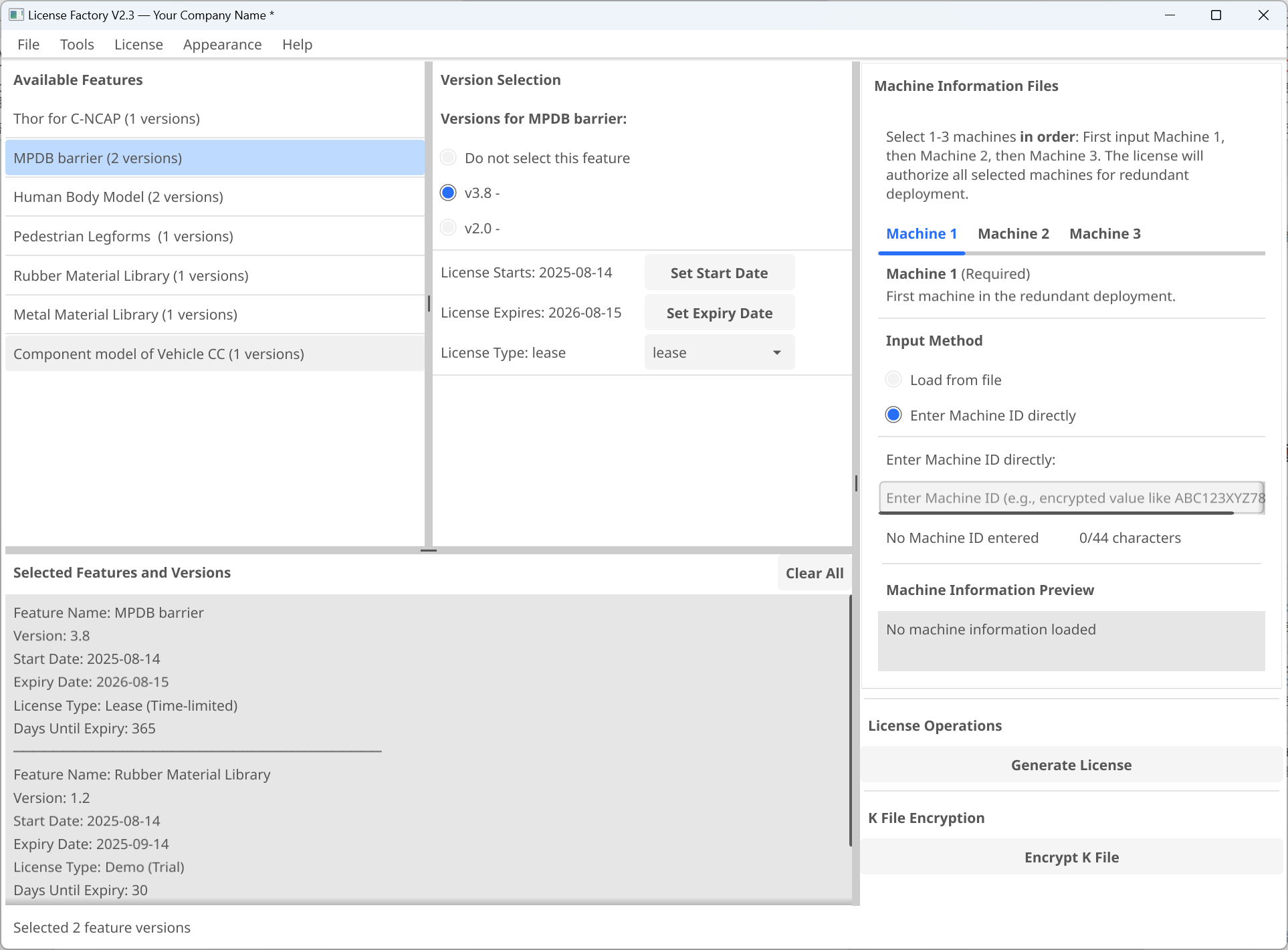
Generate a license using License Factory
Advantage:
- Customizable (add or delete) products (Feature) and versions (Version);
- Generate a License file for each Feature, or generate one License file for multiple Features;
- Utilize the existing encryption key of LS-DYNA to automatically inject the license request feature when encrypting the K file;
DYNA MODEL License Manager (Client):
The client (end user) can manage the license file, including reading in the license, viewing the license status, and authorizing the license requests needed during the LS-DYNA calculation process:
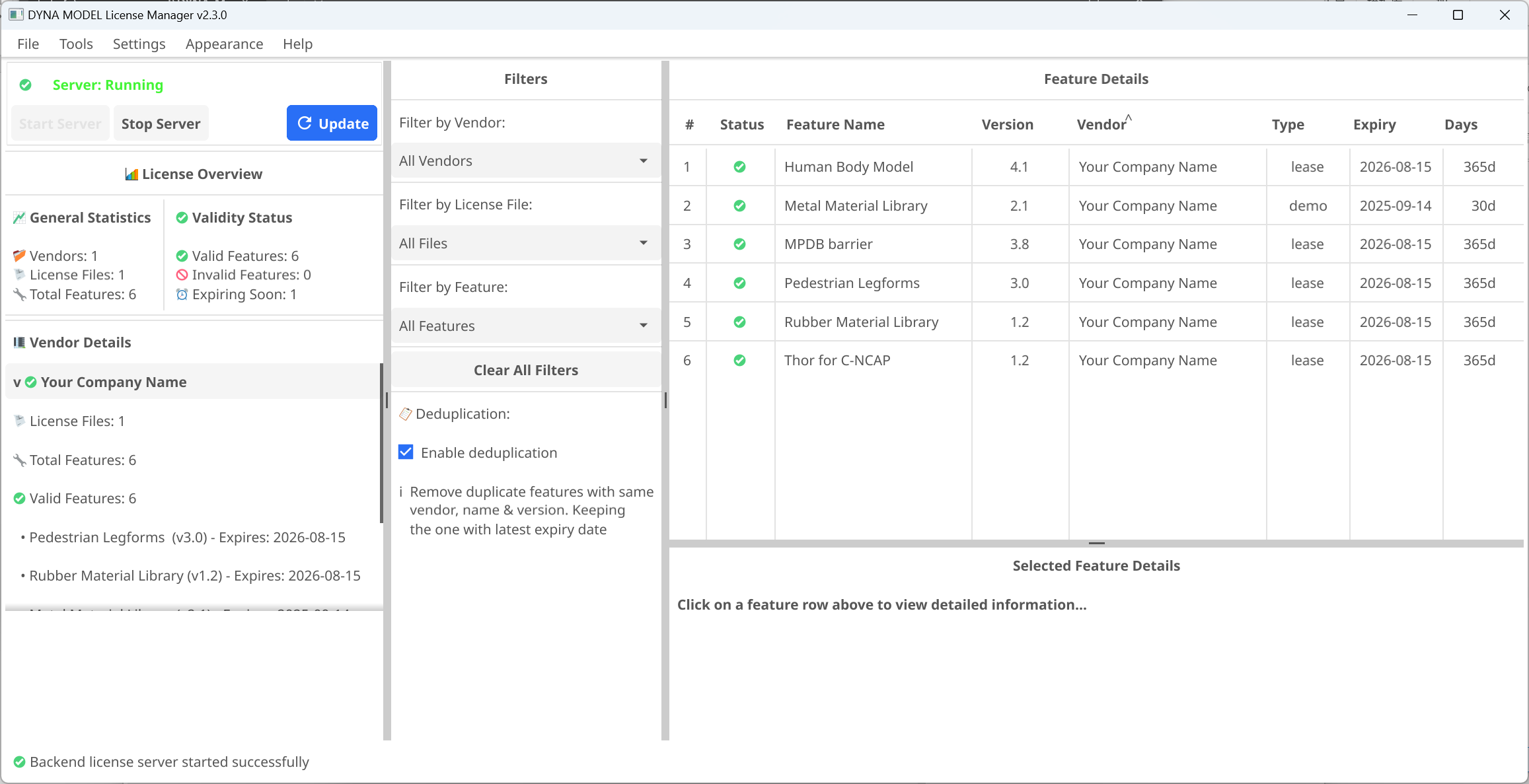
Use DYNA MODEL License Manager for license management
Advantage:
- Multiple suppliers can share a DYNA MODEL License Manager for license management;
- Each supplier can also have its own independent DYNA MODEL License Manager;
- The graphical interface includes information such as the name, version, and expiration date of your product (Feature);
- The network floating license incorporates security technologies such as machine hardware binding, virtualization detection, and time rollback protection;
Our potential users:
- LS-DYNA FEA model suppliers: dummy models, barrier models, pedestrian models, etc;
- LS-DYNA material data supplier;
- Users (automobile OEMs, component manufacturers, and other industry customers) who require time rollback protection, machine hardware binding, anti-virtualization, and anti-Docker for LS-DYNA models or material data;
Instructions:
Single/Multiple machine binding strategy. Currently, both single and multiple machine binding strategies are supported. The current multiple machine binding allows multiple machines to provide services simultaneously."Three-machine authorization, with at least two nodes online" - This feature will be introduced in subsequent versions.
DYNA MODEL License Manager - LS-DYNA Model Encryption Software
Do you want to bind and manage encryption models or material cards with machine hardware? The existing GPG encryption method only provides time protection, posing a risk of being easily copied to unauthorized machines for use.
Features of LS-DYNA model and material data license manager:
- Machine hardware binding;
- Adopting the currently popular network floating license, it can be operated within the intranet of a Linux cluster;
- Safe and reliable: TLS/HTTPS full-chain encryption + license digital signature verification + anti-virtualization/anti-Docker/anti-tampering checks + time rollback protection;
- Support license requests with a concurrency of up to 10,000, meeting the high-concurrency authorization scheduling needs of research and development centers/simulation centers;
- License Manager supports both graphical interface and command line usage;
- The License Manager service can run in operating environments such as Windows and Linux;
- For enterprise scenarios: It can autonomously generate various authorizations such as permanent, leasing, and trial;
- License usage records can be exported with one click;
License Factory (Supplier side):
The supplier (the publisher of the model or material card) uses this tool to generate the license file for the corresponding model or material card (Feature) for its customers:
Generate a license using License Factory
Advantage:
- Customizable (add or delete) products (Feature) and versions (Version);
- Generate a License file for each Feature, or generate one License file for multiple Features;
- Utilize the existing encryption key of LS-DYNA to automatically inject the license request feature when encrypting the K file;
DYNA MODEL License Manager (Client):
The client (end user) can manage the license file, including reading in the license, viewing the license status, and authorizing the license requests needed during the LS-DYNA calculation process:
Use DYNA MODEL License Manager for license management
Advantage:
- Multiple suppliers can share a DYNA MODEL License Manager for license management;
- Each supplier can also have its own independent DYNA MODEL License Manager;
- The graphical interface includes information such as the name, version, and expiration date of your product (Feature);
- The network floating license incorporates security technologies such as machine hardware binding, virtualization detection, and time rollback protection;
Our potential users:
- LS-DYNA FEA model suppliers: dummy models, barrier models, pedestrian models, etc;
- LS-DYNA material data supplier;
- Users (automobile OEMs, component manufacturers, and other industry customers) who require time rollback protection, machine hardware binding, anti-virtualization, and anti-Docker for LS-DYNA models or material data;
Instructions:
Single/Multiple machine binding strategy. Currently, both single and multiple machine binding strategies are supported. The current multiple machine binding allows multiple machines to provide services simultaneously."Three-machine authorization, with at least two nodes online" - This feature will be introduced in subsequent versions.