Fluid Simulation / Thermal Simulation
Ansys Fluent: General Fluid Simulation Software
Ansys Fluent, as the more leading fluid dynamics (CFD) simulation software, consistently ranked high in market share and popularity among like software. This easy-to-use software is designed with robust and complete features, thus being suitable for novice simulators and industry experts alike.
● Operating environment: The Fluent software can be run either stand-alone or in the integrated CAE simulation environment, namely Ansys Workbench; it's designed for convenient model and data transfer, collaborative optimization and flow-solid coupling simulation with other CAE software from Ansys.
● Solver: Incorporating a variety of solving methods such as pressure-based solving (discrete and continuous) and density-based solving (explicit equation, implicit equation), this solver is suitable for solving problems with various Mach numbers.
● Radiant heat transfer: Fluent incorporates a variety of thermal radiation models, including DO (Discrete Ordinates) model, P1 and Rossland model, discrete ray tracing module, etc., and takes into account specular reflection, penetration, refraction, anisotropic scattering, and wavelength-dependent material properties.
● Combustion and chemical reactions: Including a variety of chemical reaction models such as EDM model, EDC model, PDF model, finite-rate chemical model, and surface reaction model; some combustion models can work with large eddy simulation (DES) and separated vortex (DES) turbulence model.
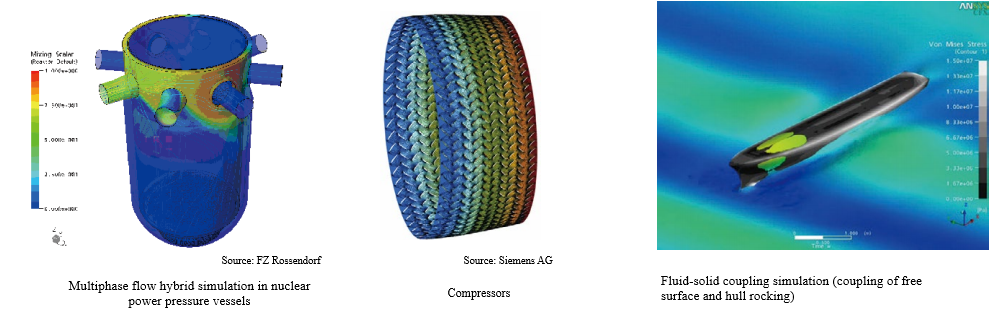
● Multiphase flow model: A variety of multiphase flow models are provided, and it is applicable for multiphase flow simulation with compressibility and more than three phases. The VOF model (Volume of Fluid) is used to simulate free surface flow problems such as sea waves.
● Dynamic areas and moving meshes: Offering a variety of re-meshing solutions and mobile morphing modes, including moving mesh model, sliding mesh, multi-reference coordinate system model, etc., thus being highly robust to complex shape changes.
● Acoustic and noise models: Various methods are available for computing the noise simulation problems resulting from fluid flow effects. Including noise sources caused by pressure pulsations; the transmission at various noise source surfaces such as non-streamlined entities and rotating fan blades.
● Add-on module: Such models as proton exchange membrane (PEM), solid oxide fuel cell (SOFC), magnetohydrodynamics (MHD), and continuous fiber-drawn modules are available.
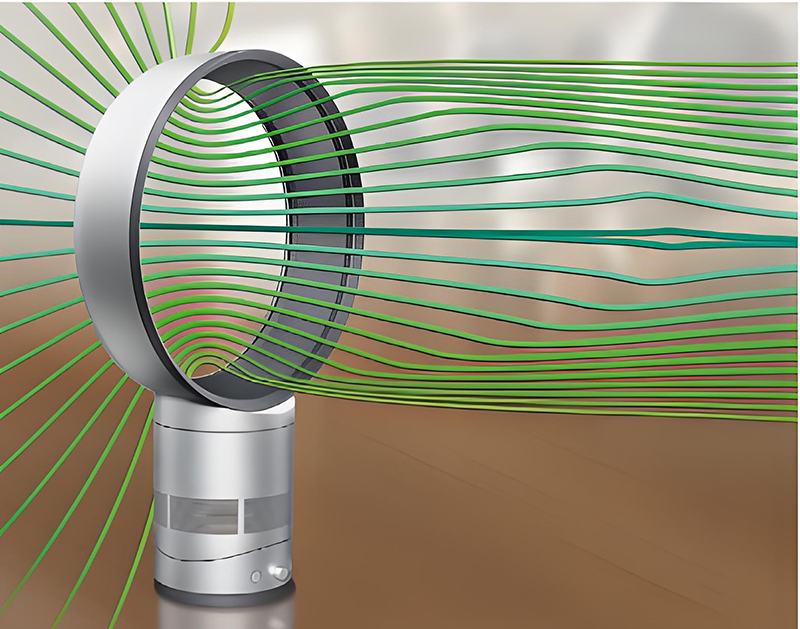
Dyson Air Multiplier
Ansys Chemkin-Pro: Detailed chemical reaction simulation
Ansys Chemkin-Pro, a gold standard for modeling and simulation of complex gas phase and surface chemical reactions, is designed for fast and accurate development of combustion systems. A reaction path analyzer is incorporated so that complex systems are modeled with reactor network to gain a more in-depth look at low-emission combustion stability, learn about and predict particle formation, easily create CFD flamelet PDF in a faster and more accurate manner, and find out how input uncertainties affect simulation results.
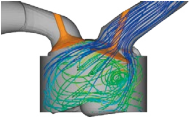
Ansys Forte: Combustion performance simulation software for internal combustion engines
As a next-generation combustion performance simulation software for internal combustion engines, Ansys Forte incorporates the gold-standard Ansys Chemkin-Pro solver technique with modeling and simulation based on extensively proven gas phase and surface chemistry; the multi-component fuel model incorporating full-scale jet dynamics is used to accurately simulate the ignition and emissions of internal combustion engines, featuring high computing accuracy, high speed, and low memory consumption.
Ansys CFX: General Fluid Simulation Software
It's the world's rarely large commercial software working with the fully implicit coupling algorithm. Thanks to the algorithmically advanced and sophisticated pre-processors and post-processors with abundant physical models, the Ansys CFX software has gained the trust of users in rotating machinery and multiphase flow engineering.
● Operating environment: It could either run alone or function in the integrated CAE simulation environment of Ansys Workbench; in a convenient manner, it could be subjected to data sharing, data transfer, and collaborative optimization with other CAE products of Ansys for fluid/solid coupling simulation.
● Solver: As the biggest feature of CFX software, the solver employs a fully implicit multi-mesh coupling algorithm, featuring robust convergence performance, high accuracy, and high speed.
● Turbulence model: It's advisable to use the highly practical turbulence model introduced by the development team led by Dr. Florian Menter, a leading authority on turbulence; the SST model, the state-of-the-art non-stationary RANS model and SAS model etc. are developed to accurately simulate complex flow phenomena such as transitional flow and separation.
● Rotating machinery: The industry-leading rotating machinery simulation capabilities, including dedicated pre- and post-processors, robust precision solver, and extended functionality (turbulence model, dynamic/static wing effect, steam, fluid/solid coupling simulation, etc.)
● Radiant heat transfer: Various radiation models (e.g., Rosseland, P1, Discrete Transfer Model, Monte Carlo, etc.) are available for simulating the materials with diversified thermal radiation properties. Expression languages require no programming; user-defined expressions conveniently define boundary conditions, sources, physical parameters, model parameters, etc. as requested.
● Acoustics and noise: It's possible to solve all fluid-related acoustics and noise problems. With special treatment for fan noise simulation, the Lowson model conveniently simulates fan noise with steady-state results without need for increasing computational effort and computational resources, and works with other acoustic simulation software for simulation.
● Fluid-solid coupling simulation: This is used with Ansys Mechanical for co-coupled simulation in the Ansys Workbench environment; complex problems are solved in straightforward processes without difficulty.
Ansys FENSAP-ICE: Aircraft icing and de-icing simulation software
Ansys FENSAP-ICE is extensively used by leading aircraft manufacturers for aircraft icing and de-icing simulation; the state-of-the-art graphical user interface and the intuitive simulation management considerably reduce the number and cost of icing test flights of aircraft, having improved the safety.
Ansys Polyflow: Finite element method based viscous and viscoelastic fluid simulation software
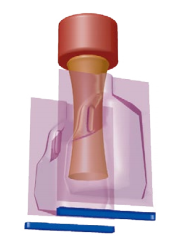
Injection molding, extrusion molding and blow molding simulations are performed with this software, which solves the problems that may arise during thermoforming, blow molding, etc.; it's extensively used for the development of forming and forming devices of plastics, rubbers, glass, ceramics, and foodstuffs (mixtures).
Fluid Simulation / Thermal Simulation
Ansys Fluent: General Fluid Simulation Software
Ansys Fluent, as the more leading fluid dynamics (CFD) simulation software, consistently ranked high in market share and popularity among like software. This easy-to-use software is designed with robust and complete features, thus being suitable for novice simulators and industry experts alike.
● Operating environment: The Fluent software can be run either stand-alone or in the integrated CAE simulation environment, namely Ansys Workbench; it's designed for convenient model and data transfer, collaborative optimization and flow-solid coupling simulation with other CAE software from Ansys.
● Solver: Incorporating a variety of solving methods such as pressure-based solving (discrete and continuous) and density-based solving (explicit equation, implicit equation), this solver is suitable for solving problems with various Mach numbers.
● Radiant heat transfer: Fluent incorporates a variety of thermal radiation models, including DO (Discrete Ordinates) model, P1 and Rossland model, discrete ray tracing module, etc., and takes into account specular reflection, penetration, refraction, anisotropic scattering, and wavelength-dependent material properties.
● Combustion and chemical reactions: Including a variety of chemical reaction models such as EDM model, EDC model, PDF model, finite-rate chemical model, and surface reaction model; some combustion models can work with large eddy simulation (DES) and separated vortex (DES) turbulence model.
● Multiphase flow model: A variety of multiphase flow models are provided, and it is applicable for multiphase flow simulation with compressibility and more than three phases. The VOF model (Volume of Fluid) is used to simulate free surface flow problems such as sea waves.
● Dynamic areas and moving meshes: Offering a variety of re-meshing solutions and mobile morphing modes, including moving mesh model, sliding mesh, multi-reference coordinate system model, etc., thus being highly robust to complex shape changes.
● Acoustic and noise models: Various methods are available for computing the noise simulation problems resulting from fluid flow effects. Including noise sources caused by pressure pulsations; the transmission at various noise source surfaces such as non-streamlined entities and rotating fan blades.
● Add-on module: Such models as proton exchange membrane (PEM), solid oxide fuel cell (SOFC), magnetohydrodynamics (MHD), and continuous fiber-drawn modules are available.
Dyson Air Multiplier
Ansys Chemkin-Pro: Detailed chemical reaction simulation
Ansys Chemkin-Pro, a gold standard for modeling and simulation of complex gas phase and surface chemical reactions, is designed for fast and accurate development of combustion systems. A reaction path analyzer is incorporated so that complex systems are modeled with reactor network to gain a more in-depth look at low-emission combustion stability, learn about and predict particle formation, easily create CFD flamelet PDF in a faster and more accurate manner, and find out how input uncertainties affect simulation results.
Ansys Forte: Combustion performance simulation software for internal combustion engines
As a next-generation combustion performance simulation software for internal combustion engines, Ansys Forte incorporates the gold-standard Ansys Chemkin-Pro solver technique with modeling and simulation based on extensively proven gas phase and surface chemistry; the multi-component fuel model incorporating full-scale jet dynamics is used to accurately simulate the ignition and emissions of internal combustion engines, featuring high computing accuracy, high speed, and low memory consumption.
Ansys CFX: General Fluid Simulation Software
It's the world's rarely large commercial software working with the fully implicit coupling algorithm. Thanks to the algorithmically advanced and sophisticated pre-processors and post-processors with abundant physical models, the Ansys CFX software has gained the trust of users in rotating machinery and multiphase flow engineering.
● Operating environment: It could either run alone or function in the integrated CAE simulation environment of Ansys Workbench; in a convenient manner, it could be subjected to data sharing, data transfer, and collaborative optimization with other CAE products of Ansys for fluid/solid coupling simulation.
● Solver: As the biggest feature of CFX software, the solver employs a fully implicit multi-mesh coupling algorithm, featuring robust convergence performance, high accuracy, and high speed.
● Turbulence model: It's advisable to use the highly practical turbulence model introduced by the development team led by Dr. Florian Menter, a leading authority on turbulence; the SST model, the state-of-the-art non-stationary RANS model and SAS model etc. are developed to accurately simulate complex flow phenomena such as transitional flow and separation.
● Rotating machinery: The industry-leading rotating machinery simulation capabilities, including dedicated pre- and post-processors, robust precision solver, and extended functionality (turbulence model, dynamic/static wing effect, steam, fluid/solid coupling simulation, etc.)
● Radiant heat transfer: Various radiation models (e.g., Rosseland, P1, Discrete Transfer Model, Monte Carlo, etc.) are available for simulating the materials with diversified thermal radiation properties. Expression languages require no programming; user-defined expressions conveniently define boundary conditions, sources, physical parameters, model parameters, etc. as requested.
● Acoustics and noise: It's possible to solve all fluid-related acoustics and noise problems. With special treatment for fan noise simulation, the Lowson model conveniently simulates fan noise with steady-state results without need for increasing computational effort and computational resources, and works with other acoustic simulation software for simulation.
● Fluid-solid coupling simulation: This is used with Ansys Mechanical for co-coupled simulation in the Ansys Workbench environment; complex problems are solved in straightforward processes without difficulty.
Ansys FENSAP-ICE: Aircraft icing and de-icing simulation software
Ansys FENSAP-ICE is extensively used by leading aircraft manufacturers for aircraft icing and de-icing simulation; the state-of-the-art graphical user interface and the intuitive simulation management considerably reduce the number and cost of icing test flights of aircraft, having improved the safety.
Ansys Polyflow: Finite element method based viscous and viscoelastic fluid simulation software
Injection molding, extrusion molding and blow molding simulations are performed with this software, which solves the problems that may arise during thermoforming, blow molding, etc.; it's extensively used for the development of forming and forming devices of plastics, rubbers, glass, ceramics, and foodstuffs (mixtures).