

Material Test&Calibration
Publishdate: Views:
Shanghai Dynawe Information Technology Co., Ltd. works with well-known material test labs in China to provide customers with services of the sample tests on mechanical properties of materials and the generation of LS-DYNA software material cards, as follows:
- Performing sample tests (unidirectional tensile test, notch tensile test, shear test, biaxial tensile test, punching test, three-point bending test, etc.) on various (metallic or non-metallic) materials according to customers' technical requirements.
- Data processing, validation and simulation analysis calibration for material sample test results.
- Output simulation analysis calibration results, and generate appropriate LS-DYNA software material cards based on various constitutive requirements on materials.
- Delivering the material sample test data results and LS-DYNA software material cards.
Material sample tests:
The material sample tests required vary depending on customers' relevant technical requirements and the material card constitutive models generated:
For example, the LS-DYNA software MAT24 material card (for metallic materials) is normally generated with the following tests:
1) Quasi-static tensile test
2 sets of quasi-static tensile tests are performed at a strain rate of 0.001/s and 0.1/s; at least 3 sets (or 5 sets) of tests are needed; tests are performed with MTS 810 at a maximum load of 50 kN; the dimensions of test samples are subject to GBT 228.1-2010 Metallic Materials - Tensile Testing - Method of Test at Ambient Temperature.
2) Tensile test at medium strain rate
5 sets of tensile tests at medium strain rates (0.1/s, 1/s, 10/s, 100/s, and 500/s) are performed, and 3 sets (or 5 sets) are repeated; tests are performed with zwick HTM 5020 at a max. load of 50 kN and a max. tensile speed of 20 m/s; the dimensions of test samples are subject to GBT 30069.2-2016 Metallic Materials - Tensile Testing at High Strain Rates - Part 2: Servo-hydraulic and Other Test Systems.
For example, the LS-DYNA software MAT187 material card (for non-metallic materials) is normally generated with the following tests:
1) Quasi-static tensile test
2 sets of quasi-static tensile tests are performed at a strain rate of 0.001/s and 0.1/s; at least 3 sets of tests are needed; tests are performed with Instron5966 at a maximum load of 10 kN; the dimensions of test samples are subject to GB_T 37426-2019 Plastic - Dimensions.
2) Tensile test at medium strain rate
5 sets of tensile tests are performed at a medium strain rate of 0.1/s, 1/s, 10/s, 100/s, and 500/s; at least 3 sets of tests are repeated; tests are performed with zwick HTM 5020 at a maximum load of 50 kN and a max. tensile speed of 20 m/s; the dimensions of test samples are subject to GB_T 37426-2019 Plastic - Dimensions.
3) Compression test
2 sets of compression tests are performed at a strain rate of 0.001/s and 0.01/s; at least 3 sets of tests are repeated; tests are performed with Instron 5966 at a maximum load of 10 kN; the dimensions of test samples are subject to GB_T 8813-2020.
4) Three-point bending test
High-speed three-point bending tests for non-metallic material are performed at 50 mm/s, 150 mm/s, and 300 mm/s; 3 tests are repeated; tests are performed with zwick HTM 5020 at a max. load of 50 kN.
5) High-speed perforation test
This test could be subject to ISO6603-2-2000 Plastics - Determination of Puncture Impact Behavior of Rigid Plastics - Part 2: Instrumented Impact Testing, at an impact velocity of 1-5 m/s.
If material failure models, such as GISSMO, DIEM, MMC or Johnson-Cook models, need to be considered, additional tests will be required; additionally, depending on the constitutive requirements of the LS-DYNA software on material, this may involve anisotropic sampling and the testing of mechanical properties of the materials at different temperatures.
Material test data verification calibration and LS-DYNA card generati
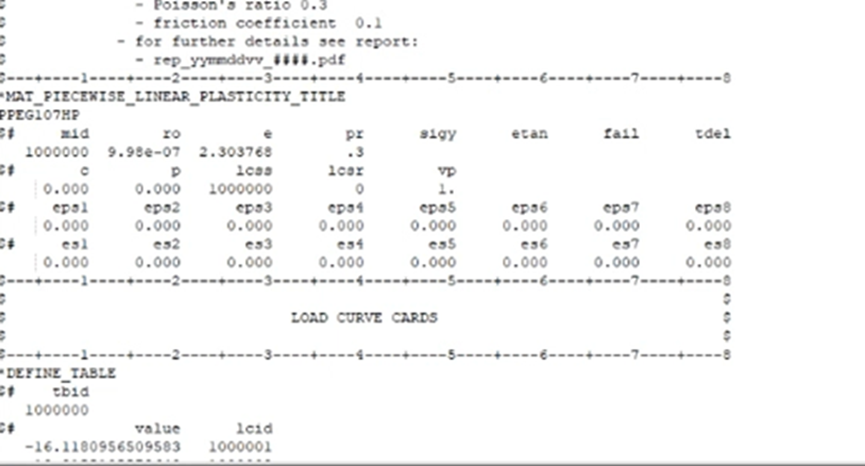
With the above material sample test data, we need to verify and calibrate the test data using various methods for these material data, and use tools to generate material cards for LS-DYNA software, ending up with material cards in Keyword format, which can be directly called by customers and used for LS-DYNA solution calculations.
We use 4A Engineering's VALIMAT software to achieve fast and efficient calibration of test data and generation of material cards.
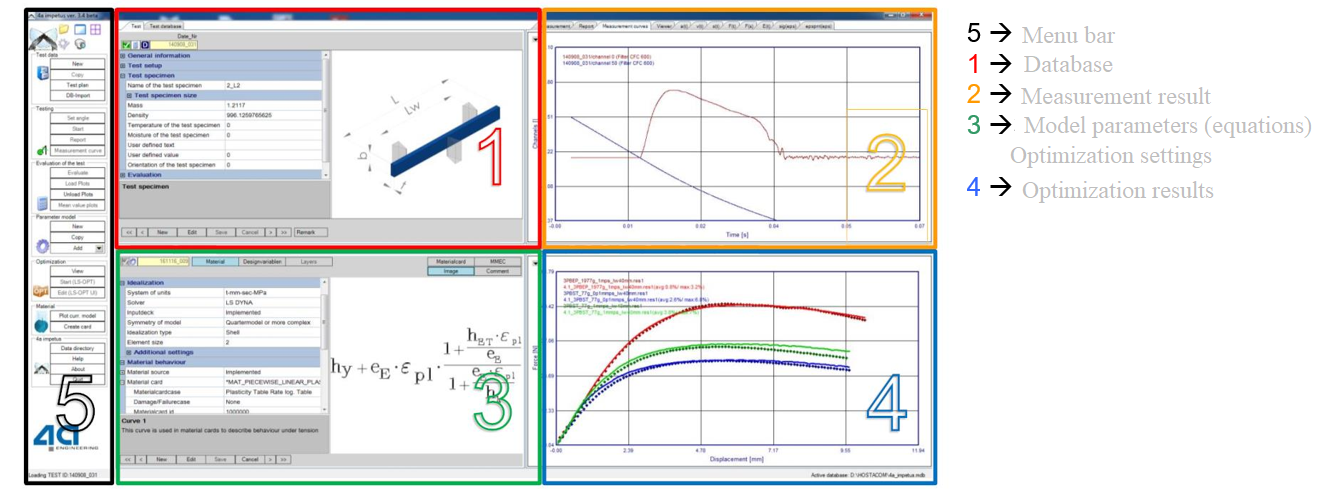
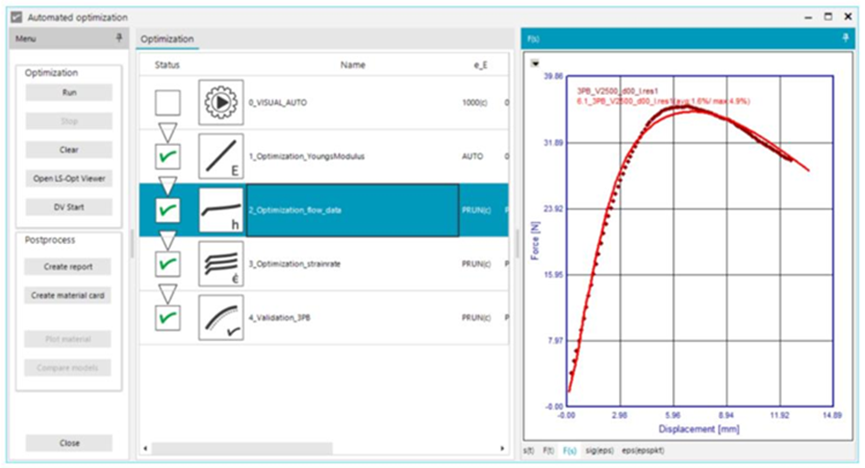
The general procedure is as follows: Importing the test data of the series of samples; automatically generating the corresponding CAE analysis models; parameterizing the models; calling LS-OPT optimization software to optimize the material curve parameters for automatic calibration and yielding of the calibrated material curves:
The corresponding material cards are then automatically or semi-automatically generated based on constitutive models of materials selected:
Shanghai Dynawe Information Technology Co., Ltd. works with well-known material test labs in China to provide customers with services of the sample tests on mechanical properties of materials and the generation of LS-DYNA software material cards, as follows:
- Performing sample tests (unidirectional tensile test, notch tensile test, shear test, biaxial tensile test, punching test, three-point bending test, etc.) on various (metallic or non-metallic) materials according to customers' technical requirements.
- Data processing, validation and simulation analysis calibration for material sample test results.
- Output simulation analysis calibration results, and generate appropriate LS-DYNA software material cards based on various constitutive requirements on materials.
- Delivering the material sample test data results and LS-DYNA software material cards.
Material sample tests:
The material sample tests required vary depending on customers' relevant technical requirements and the material card constitutive models generated:
For example, the LS-DYNA software MAT24 material card (for metallic materials) is normally generated with the following tests:
1) Quasi-static tensile test
2 sets of quasi-static tensile tests are performed at a strain rate of 0.001/s and 0.1/s; at least 3 sets (or 5 sets) of tests are needed; tests are performed with MTS 810 at a maximum load of 50 kN; the dimensions of test samples are subject to GBT 228.1-2010 Metallic Materials - Tensile Testing - Method of Test at Ambient Temperature.
2) Tensile test at medium strain rate
5 sets of tensile tests at medium strain rates (0.1/s, 1/s, 10/s, 100/s, and 500/s) are performed, and 3 sets (or 5 sets) are repeated; tests are performed with zwick HTM 5020 at a max. load of 50 kN and a max. tensile speed of 20 m/s; the dimensions of test samples are subject to GBT 30069.2-2016 Metallic Materials - Tensile Testing at High Strain Rates - Part 2: Servo-hydraulic and Other Test Systems.
For example, the LS-DYNA software MAT187 material card (for non-metallic materials) is normally generated with the following tests:
1) Quasi-static tensile test
2 sets of quasi-static tensile tests are performed at a strain rate of 0.001/s and 0.1/s; at least 3 sets of tests are needed; tests are performed with Instron5966 at a maximum load of 10 kN; the dimensions of test samples are subject to GB_T 37426-2019 Plastic - Dimensions.
2) Tensile test at medium strain rate
5 sets of tensile tests are performed at a medium strain rate of 0.1/s, 1/s, 10/s, 100/s, and 500/s; at least 3 sets of tests are repeated; tests are performed with zwick HTM 5020 at a maximum load of 50 kN and a max. tensile speed of 20 m/s; the dimensions of test samples are subject to GB_T 37426-2019 Plastic - Dimensions.
3) Compression test
2 sets of compression tests are performed at a strain rate of 0.001/s and 0.01/s; at least 3 sets of tests are repeated; tests are performed with Instron 5966 at a maximum load of 10 kN; the dimensions of test samples are subject to GB_T 8813-2020.
4) Three-point bending test
High-speed three-point bending tests for non-metallic material are performed at 50 mm/s, 150 mm/s, and 300 mm/s; 3 tests are repeated; tests are performed with zwick HTM 5020 at a max. load of 50 kN.
5) High-speed perforation test
This test could be subject to ISO6603-2-2000 Plastics - Determination of Puncture Impact Behavior of Rigid Plastics - Part 2: Instrumented Impact Testing, at an impact velocity of 1-5 m/s.
If material failure models, such as GISSMO, DIEM, MMC or Johnson-Cook models, need to be considered, additional tests will be required; additionally, depending on the constitutive requirements of the LS-DYNA software on material, this may involve anisotropic sampling and the testing of mechanical properties of the materials at different temperatures.
Material test data verification calibration and LS-DYNA card generati
With the above material sample test data, we need to verify and calibrate the test data using various methods for these material data, and use tools to generate material cards for LS-DYNA software, ending up with material cards in Keyword format, which can be directly called by customers and used for LS-DYNA solution calculations.
We use 4A Engineering's VALIMAT software to achieve fast and efficient calibration of test data and generation of material cards.
The general procedure is as follows: Importing the test data of the series of samples; automatically generating the corresponding CAE analysis models; parameterizing the models; calling LS-OPT optimization software to optimize the material curve parameters for automatic calibration and yielding of the calibrated material curves:
The corresponding material cards are then automatically or semi-automatically generated based on constitutive models of materials selected: